215 posters, 5 topics, 22 sessions, 596 authors, 283 institutions
ePostersLive by SciGen Technologies S.A. All rights reserved.
Obstetric Anaesthesia Annual Scientific Meeting 2025
May 15 - 16, 2025 | ICC, 2 Lanyon Place, Belfast BT1 3WH

6781101
Acute, type A, aortic dissection in the third trimester -- a case report
Poster Presenter
Authors
Affiliations
Part of Topic
Case report
Acute, Type A, Aortic Dissection in The Third Trimester – A Case Report
Dr Emma Bryson (ST7), Dr Alex Feben (ST7), Dr Elliot Robbie (ST2) Kings College Hospital
Introduction
Aortic dissection in pregnancy is a rare complication (1.3 per 100,000 pregnancies) with a high resultant mortality rate [1][2].
We present a case of a 42 year old multiparous woman at 32 weeks gestation in her fourth pregnancy, with successful outcomes for mother and baby.
Case Report
The patient presented to triage with sudden onset central chest pain. Prompt and thorough examination by the Obstetric resident revealed a loud diastolic murmur.
Worsening pain expedited an ECHO, which demonstrated torrential Aortic Regurgitation with a dilated aortic root and likely dissection flap. Bilateral blood pressures showed a discrepancy of 20mmHg.
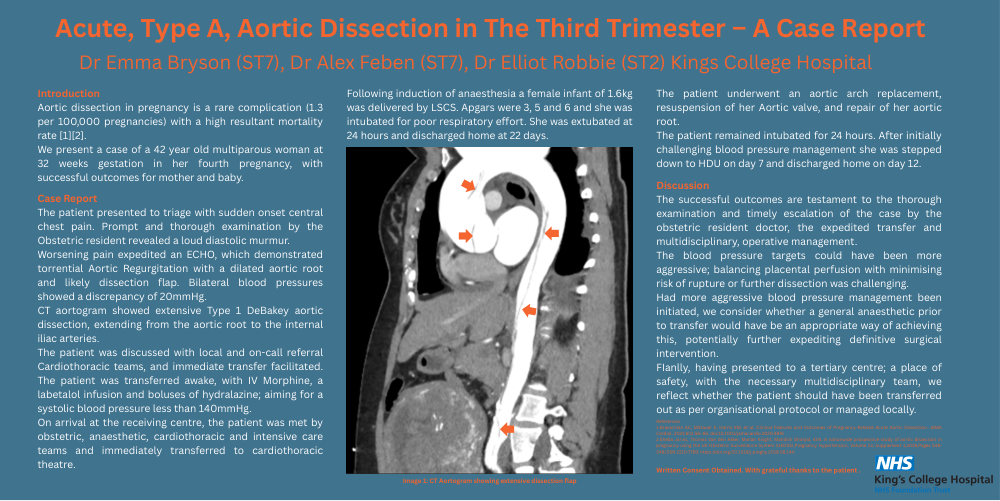
CT aortogram showed extensive Type 1 DeBakey aortic dissection, extending from the aortic root to the internal iliac arteries.
The patient was discussed with local and on-call referral Cardiothoracic teams, and immediate transfer facilitated. The patient was transferred awake, with IV Morphine, a labetalol infusion and boluses of hydralazine; aiming for a systolic blood pressure less than 140mmHg.
On arrival at the receiving centre, the patient was met by obstetric, anaesthetic, cardiothoracic and intensive care teams and immediately transferred to cardiothoracic theatre.
Following induction of anaesthesia a female infant of 1.6kg was delivered by LSCS. Apgars were 3, 5 and 6 and she was intubated for poor respiratory effort. She was extubated at 24 hours and discharged home at 22 days.
The patient underwent an aortic arch replacement, resuspension of her Aortic valve, and repair of her aortic root.
The patient remained intubated for 24 hours. After initially challenging blood pressure management she was stepped down to HCU on day 7 and discharged home on day 12.
Discussion
The successful outcomes are testament to the thorough examination and timely escalation of the case by the obstetric resident doctor, the expedited transfer and multidisciplinary, operative management.
The blood pressure targets could have been more aggressive; balancing placental perfusion with minimising risk of rupture or further dissection was challenging.
Had more aggressive blood pressure management been initiated, we consider whether a general anaesthetic prior to transfer would have be an appropriate way of achieving this, potentially further expediting definitive surgical intervention.
FIanlly, having presented to a tertiary centre; a place of safety, with the necessary multidisciplinary team, we reflect whether the patient should have been transferred out as per organisational protocol or managed locally.