215 posters, 5 topics, 22 sessions, 596 authors, 283 institutions
ePostersLive by SciGen Technologies S.A. All rights reserved.
Obstetric Anaesthesia Annual Scientific Meeting 2025
May 15 - 16, 2025 | ICC, 2 Lanyon Place, Belfast BT1 3WH

6772972
HELLP! They are hypotensive!
Poster Presenter
Authors
Affiliations
Part of Topic
Case report
HELLP! They are hypotensive!
By Alice Paterson-Brown, Arun Tohani, Lorraine Hamlyn ; Queen Charlotte’s and Chelsea Hospital
Introduction
A 35-year-old woman with severe pre-eclampsia (PET) and HELLP syndrome (haemolysis, elevated liver enzymes, low platelets) developed intractable hypotension during an emergency caesarean section (CS), with no obvious cause.
Case Report
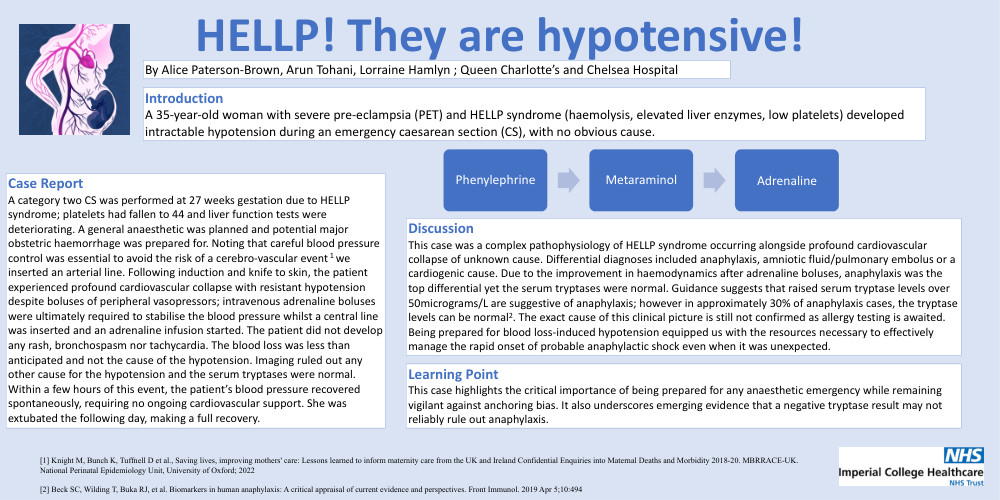
A category two CS was performed at 27 weeks gestation due to HELLP syndrome; platelets had fallen to 44 and liver function tests were deteriorating. A general anaesthetic was planned and potential major obstetric haemorrhage was prepared for. Noting that careful blood pressure control was essential to avoid the risk of a cerebro-vascular event 1 we inserted an arterial line. Following induction and knife to skin, the patient experienced profound cardiovascular collapse with resistant hypotension despite boluses of peripheral vasopressors; intravenous adrenaline boluses were ultimately required to stabilise the blood pressure whilst a central line was inserted and an adrenaline infusion started. The patient did not develop any rash, bronchospasm nor tachycardia. The blood loss was less than anticipated and not the cause of the hypotension. Imaging ruled out any other cause for the hypotension and the serum tryptases were normal. Within a few hours of this event, the patient’s blood pressure recovered spontaneously, requiring no ongoing cardiovascular support. She was extubated the following day, making a full recovery.
Discussion
This case was a complex pathophysiology of HELLP syndrome occurring alongside profound cardiovascular collapse of unknown cause. Differential diagnoses included anaphylaxis, amniotic fluid/pulmonary embolus or a cardiogenic cause. Due to the improvement in haemodynamics after adrenaline boluses, anaphylaxis was the top differential yet the serum tryptases were normal. Guidance suggests that raised serum tryptase levels over 50micrograms/L are suggestive of anaphylaxis; however in approximately 30% of anaphylaxis cases, the tryptase levels can be normal2. The exact cause of this clinical picture is still not confirmed as allergy testing is awaited. Being prepared for blood loss-induced hypotension equipped us with the resources necessary to effectively manage the rapid onset of probable anaphylactic shock even when it was unexpected.
Learning Point
This case highlights the critical importance of being prepared for any anaesthetic emergency while remaining
vigilant against anchoring bias. It also underscores emerging evidence that a negative tryptase result may not reliably rule out anaphylaxis.