215 posters, 5 topics, 22 sessions, 596 authors, 283 institutions
ePostersLive by SciGen Technologies S.A. All rights reserved.
Obstetric Anaesthesia Annual Scientific Meeting 2025
May 15 - 16, 2025 | ICC, 2 Lanyon Place, Belfast BT1 3WH

6780795
Case report of late epidural blood patch
Poster Presenter
Authors
Ugne Valanciute, Justina Jermolajevaite, Lukosiene Laura, Rimaitis Kestutis, Andrius Macas
Affiliations
The Hospital of Lithuanian University of Health Sciences Kaunas clinics, Department of Anaesthesiology, Kaunas, Lithuania, Lithuanian University of Health Sciences, Department of Anaesthesiology, Kaunas, Lithuania, The Hospital of Lithuanian University of Health Sciences Kauno klinikos
Part of Topic
Case report
Late epidural blood patch. Case report
Valanciute U.1, Jermolajevaite J.1 , Lukosiene L. 1,2, Rimaitis K. 1,2 , Macas A. 1,2
1. Hospital of Lithuanian University of Health Sciences Kaunas Clinics, Department of Anaesthesiology, Kaunas, Lithuania
2. Lithuanian University of Health Sciences, Department of Anaesthesiology, Kaunas, Lithuania
Introduction
Epidural anaesthesia can have many complications and one of them is dural puncture, which could cause postdural puncture headache (PDPH) [1]. Epidural blood patch (EBP) is a gold standard treatment option, according to the guidelines, and the mostly used timing is 24- 48 hours after dural puncture event. Headaches could occur after labour, however, not all of them may be attributed to PDPH [2]. We aim to present and discuss clinical case of effective late epidural blood patch done 6 days after epidural anesthesia even the dural puncture was not seen in time of performing epidural.
Case report
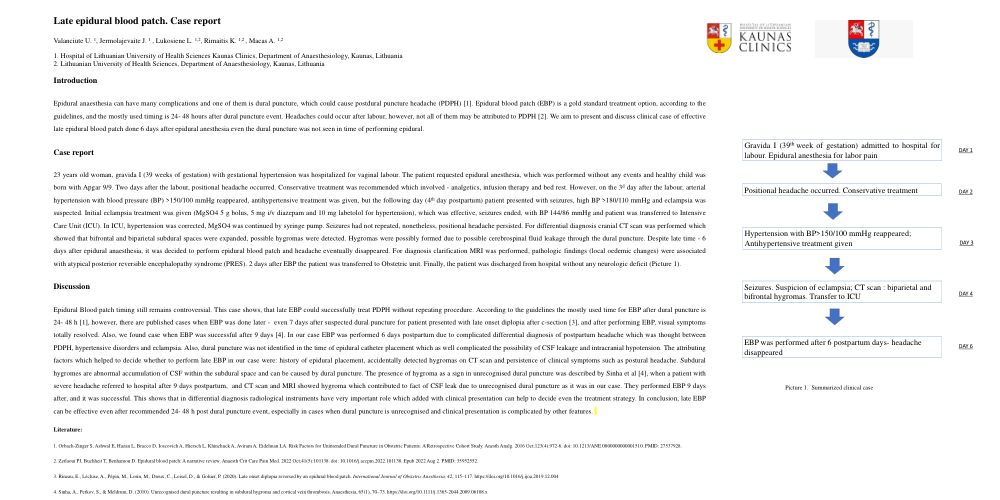
23 years old woman, gravida I (39 weeks of gestation) with gestational hypertension was hospitalized for vaginal labour. The patient requested epidural anesthesia, which was performed without any events and healthy child was born with Apgar 9/9. Two days after the labour, positional headache occurred. Conservative treatment was recommended which involved - analgetics, infusion therapy and bed rest. However, on the 3d day after the labour, arterial hypertension with blood pressure (BP) >150/100 mmHg reappeared, antihypertensive treatment was given, but the following day (4th day postpartum) patient presented with seizures, high BP >180/110 mmHg and eclampsia was suspected. Initial eclampsia treatment was given (MgSO4 5 g bolus, 5 mg i/v diazepam and 10 mg labetolol for hypertension), which was effective, seizures ended, with BP 144/86 mmHg and patient was transferred to Intensive Care Unit (ICU). In ICU, hypertension was corrected, MgSO4 was continued by syringe pump. Seizures had not repeated, nonetheless, positional headache persisted. For differential diagnosis cranial CT scan was performed which showed that bifrontal and biparietal subdural spaces were expanded, possible hygromas were detected. Hygromas were possibly formed due to possible cerebrospinal fluid leakage through the dural puncture. Despite late time - 6 days after epidural anaesthesia, it was decided to perform epidural blood patch and headache eventually disappeared. For diagnosis clarification MRI was performed, pathologic findings (local oedemic changes) were associated with atypical posterior reversible encephalopathy syndrome (PRES). 2 days after EBP the patient was transferred to Obstetric unit. Finally, the patient was discharged from hospital without any neurologic deficit (Picture 1).
Discussion
Epidural Blood patch timing still remains controversial. This case shows, that late EBP could successfully treat PDPH without repeating procedure. According to the guidelines the mostly used time for EBP after dural puncture is 24- 48 h [1], however, there are published cases when EBP was done later - even 7 days after suspected dural puncture for patient presented with late onset diplopia after c-section [3], and after performing EBP, visual symptoms totally resolved. Also, we found case when EBP was successful after 9 days [4]. In our case EBP was performed 6 days postpartum due to complicated differential diagnosis of postpartum headache which was thought between PDPH, hypertensive disorders and eclampsia. Also, dural puncture was not identified in the time of epidural catheter placement which as well complicated the possibility of CSF leakage and intracranial hypotension. The attributing factors which helped to decide whether to perform late EBP in our case were: history of epidural placement, accidentally detected hygromas on CT scan and persistence of clinical symptoms such as postural headache. Subdural hygromes are abnormal accumulation of CSF within the subdural space and can be caused by dural puncture. The presence of hygroma as a sign in unrecognised dural puncture was described by Sinha et al [4], when a patient with severe headache referred to hospital after 9 days postpartum, and CT scan and MRI showed hygroma which contributed to fact of CSF leak due to unrecognised dural puncture as it was in our case. They performed EBP 9 days after, and it was successful. This shows that in differential diagnosis radiological instruments have very important role which added with clinical presentation can help to decide even the treatment strategy. In conclusion, late EBP can be effective even after recommended 24- 48 h post dural puncture event, especially in cases when dural puncture is unrecognised and clinical presentation is complicated by other features.
Literature:
1. Orbach-Zinger S, Ashwal E, Hazan L, Bracco D, Ioscovich A, Hiersch L, Khinchuck A, Aviram A, Eidelman LA. Risk Factors for Unintended Dural Puncture in Obstetric Patients: A Retrospective Cohort Study. Anesth Analg. 2016 Oct;123(4):972-6. doi: 10.1213/ANE.0000000000001510. PMID: 27537928.
2. Zetlaoui PJ, Buchheit T, Benhamou D. Epidural blood patch: A narrative review. Anaesth Crit Care Pain Med. 2022 Oct;41(5):101138. doi: 10.1016/j.accpm.2022.101138. Epub 2022 Aug 2. PMID: 35952552.
3. Rineau, E., Lécluse, A., Pépin, M., Lorin, M., Dreux, C., Loisel, D., & Gohier, P. (2020). Late onset diplopia reversed by an epidural blood patch. International Journal of Obstetric Anesthesia, 42, 115–117. https://doi.org/10.1016/j.ijoa.2019.12.004
4. Sinha, A., Petkov, S., & Meldrum, D. (2010). Unrecognised dural puncture resulting in subdural hygroma and cortical vein thrombosis. Anaesthesia, 65(1), 70–73. https://doi.org/10.1111/j.1365-2044.2009.06108.x