215 posters, 5 topics, 22 sessions, 596 authors, 283 institutions
ePostersLive by SciGen Technologies S.A. All rights reserved.
Obstetric Anaesthesia Annual Scientific Meeting 2025
May 15 - 16, 2025 | ICC, 2 Lanyon Place, Belfast BT1 3WH

6780620
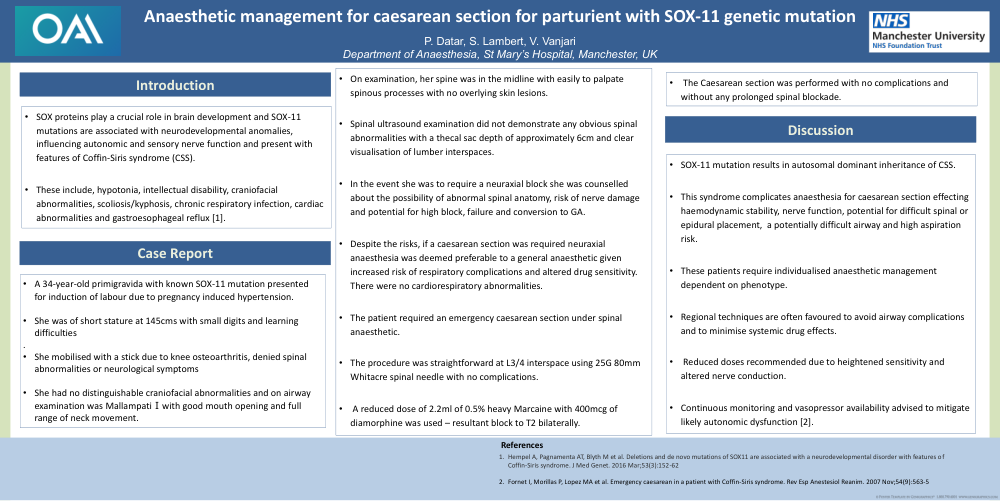
Anaesthetic management for caesarean section for parturient with SOX-11 genetic mutation
Poster Presenter
Authors
Affiliations
Part of Topic
Case report
Anaesthetic management for caesarean section for parturient with SOX-11 genetic mutation
Introduction
•SOX proteins play a crucial role in brain development and SOX-11 mutations are associated with neurodevelopmental anomalies, influencing autonomic and sensory nerve function and present with features of Coffin-Siris syndrome (CSS).
•
•These include, hypotonia, intellectual disability, craniofacial abnormalities, scoliosis/kyphosis, chronic respiratory infection, cardiac abnormalities and gastroesophageal reflux [1].
Case Report
•A 34-year-old primigravida with known SOX-11 mutation presented for induction of labour due to pregnancy induced hypertension.
•
•She was of short stature at 145cms with small digits and learning difficulties
.
•She mobilised with a stick due to knee osteoarthritis, denied spinal abnormalities or neurological symptoms
•
•She had no distinguishable craniofacial abnormalities and on airway examination wasMallampatiⅠwith good mouth opening and full range of neck movement.
•On examination, her spine was in the midline with easily to palpate spinous processes with no overlying skin lesions.
•
•Spinal ultrasound examination did not demonstrate any obvious spinal abnormalities with a thecal sac depth of approximately 6cm and clear visualisation of lumber interspaces.
•
•In the event she was to require a neuraxial block she was counselled about the possibility of abnormal spinal anatomy, risk of nerve damage and potential for high block, failure and conversion to GA.
•
•Despite the risks, if a caesarean section was required neuraxial anaesthesia was deemed preferable to a general anaesthetic given increased risk of respiratory complications and altered drug sensitivity. There were no cardiorespiratory abnormalities.
•
•The patient required an emergency caesarean section under spinal anaesthetic.
•
•The procedure was straightforward at L3/4 interspace using 25G 80mm Whitacre spinal needle with no complications.
•
• A reduced dose of 2.2ml of 0.5% heavy Marcaine with 400mcg of diamorphine was used – resultant block to T2 bilaterally.
The Caesarean section was performed with no complications and without any prolonged spinal blockade
Discussion
•SOX-11 mutation results in autosomal dominant inheritance of CSS.
•
•This syndrome complicates anaesthesia for caesarean section effecting haemodynamic stability, nerve function, potential for difficult spinal or epidural placement, a potentially difficult airway and high aspiration risk.
•
•These patients require individualised anaesthetic management dependent on phenotype.
•Regional techniques are often favoured to avoid airway complications and to minimise systemic drug effects.
•
• Reduced doses recommended due to heightened sensitivity and altered nerve conduction.
•
•Continuous monitoring and vasopressor availability advised to mitigate likely autonomic dysfunction [2].