215 posters, 5 topics, 22 sessions, 596 authors, 283 institutions
ePostersLive by SciGen Technologies S.A. All rights reserved.
Obstetric Anaesthesia Annual Scientific Meeting 2025
May 15 - 16, 2025 | ICC, 2 Lanyon Place, Belfast BT1 3WH

6780475
Method of anaesthetic antenatal review of women with morbid obesity: A national survey
Poster Presenter
Authors
Affiliations
Part of Topic
Surveys
Method of Anaesthetic Antenatal Review of Women Living with Morbid Obesity: A National Survey
Dr Roshangani Ranamuni, Dr Megan Jones, Dr Claire Williams
Department of Anaesthesia – Rosie Hospital, CUHFT
Introduction
Obesity in pregnancy is an escalating global health concern, associated with a higher risk of peripartum complications. As a result, there is an increasing demand for antenatal anaesthetic assessments, adding further strain to already stretched services that are managing rising maternal medical complexity overall. While organisations such as the Royal College of Anaesthetists (RCoA) and the Royal College of Obstetricians and Gynaecologists (RCOG) have issued guidance, there is currently no national consensus on the optimal approach to antenatal anaesthetic assessment in obese pregnant women.
Method
We conducted a national survey consisting of 14 questions, which was distributed to all lead obstetric anaesthetists following peer review by the Obstetric Anaesthetists’ Association (OAA). The survey addressed the availability of antenatal anaesthetic clinics, Body Mass Index (BMI) thresholds for review, methods of antenatal assessment, guidance for review upon admission for birth, and other related topics.
Results
Responses were received from 47 individuals. The average number of annual deliveries at their centres was 3,386, with a median and mode of 3,000. Among these centres, 11% did not have a designated antenatal clinic.
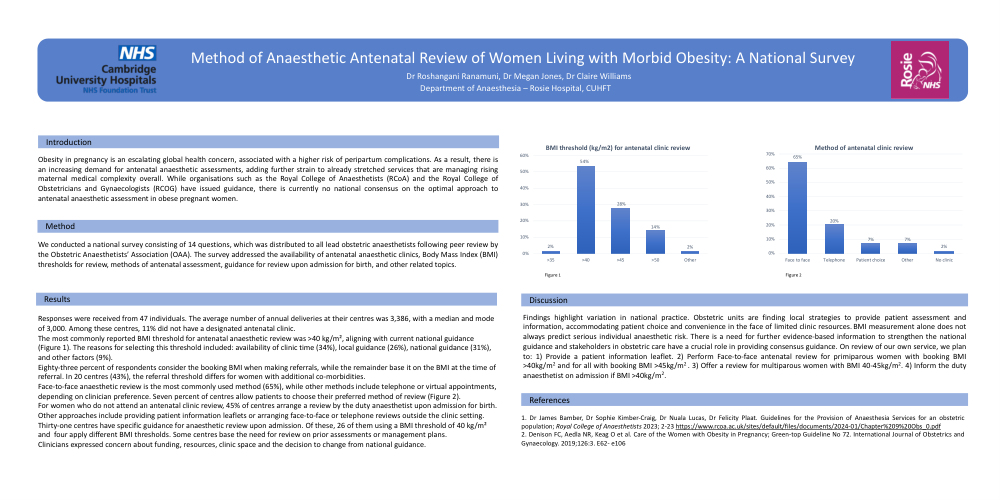
The most commonly reported BMI threshold for antenatal anaesthetic review was >40 kg/m², aligning with current national guidance (Figure 1). The reasons for selecting this threshold included: availability of clinic time (34%), local guidance (26%), national guidance (31%), and other factors (9%).
Eighty-three percent of respondents consider the booking BMI when making referrals, while the remainder base it on the BMI at the time of referral. In 20 centres (43%), the referral threshold differs for women with additional co-morbidities.
Face-to-face anaesthetic review is the most commonly used method (65%), while other methods include telephone or virtual appointments, depending on clinician preference. Seven percent of centres allow patients to choose their preferred method of review (Figure 2).
For women who do not attend an antenatal clinic review, 45% of centres arrange a review by the duty anaesthetist upon admission for birth. Other approaches include providing patient information leaflets or arranging face-to-face or telephone reviews outside the clinic setting.
Thirty-one centres have specific guidance for anaesthetic review upon admission. Of these, 26 of them using a BMI threshold of 40 kg/m² and four apply different BMI thresholds. Some centres base the need for review on prior assessments or management plans.
Clinicians expressed concern about funding, resources, clinic space and the decision to change from national guidance.
Discussion
Findings highlight variation in national practice. Obstetric units are finding local strategies to provide patient assessment and information, accommodating patient choice and convenience in the face of limited clinic resources. BMI measurement alone does not always predict serious individual anaestheticrisk. There is a need for further evidence-based information to strengthen the national guidance and stakeholders in obstetric care have a crucial role in providing consensus guidance. On review of our own service, we plan to: 1) Provide a patient information leaflet. 2) Perform Face-to-face antenatal review for primiparous women with booking BMI >40kg/m2 and for all with booking BMI >45kg/m2 . 3) Offer a review for multiparous women with BMI 40-45kg/m2. 4) Inform the duty anaesthetist on admission if BMI >40kg/m2.
References
1. Dr James Bamber, Dr Sophie Kimber-Craig, Dr Nuala Lucas, Dr Felicity Plaat. Guidelines for the Provision of Anaesthesia Services for an obstetric population; Royal College of Anaesthetists 2023; 2-23 https://www.rcoa.ac.uk/sites/default/files/documents/2024-01/Chapter%209%20Obs_0.pdf
2. Denison FC, Aedla NR, Keag O et al. Care of the Women with Obesity in Pregnancy; Green-top Guideline No 72. International Journal of Obstetrics and Gynaecology. 2019;126:3. E62- e106