215 posters, 5 topics, 22 sessions, 596 authors, 283 institutions
ePostersLive by SciGen Technologies S.A. All rights reserved.
Obstetric Anaesthesia Annual Scientific Meeting 2025
May 15 - 16, 2025 | ICC, 2 Lanyon Place, Belfast BT1 3WH

6772749
Current practice and opinions of obstetric anaesthetists in regard to guidelines and recommendations for fasting during labour in a tertiary hospital
Poster Presenter
Authors
Affiliations
Part of Topic
Surveys
Introduction
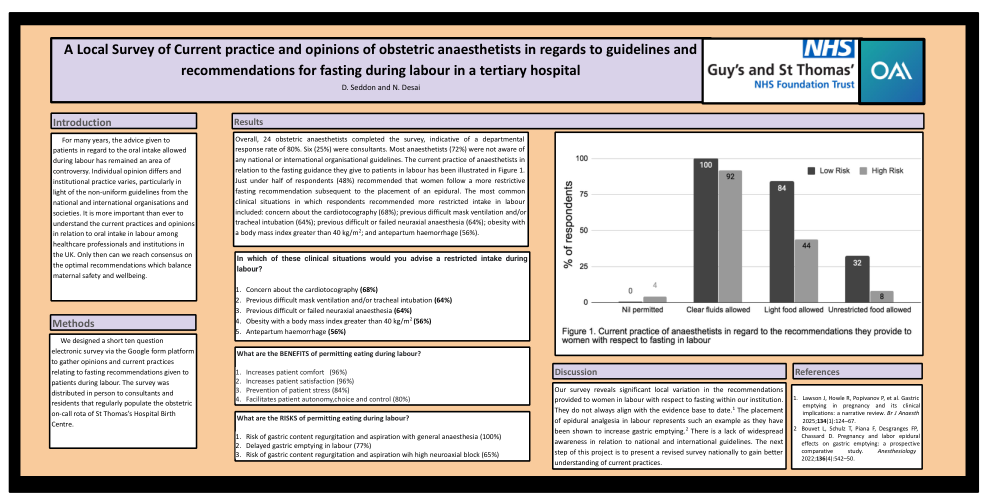
For many years, the advice given to patients in regard to the oral intake allowed during labour has remained an area of controversy. Individual opinion differs and institutional practice varies, particularly in light of the non-uniform guidelines from the national and international organisations and societies. It is more important than ever to understand the current practices and opinions in relation to oral intake in labour among healthcare professionals and institutions in the UK. Only then can we reach consensus on the optimal recommendations which balance maternal safety and wellbeing.
We designed a short ten question electronic survey via the Google form platform to gather opinions and current practices relating to fasting recommendations given to patients during labour. The survey was distributed in person to consultants and residents that regularly populate the obstetric on-call rota of St Thomas’s Hospital Birth Centre.
Discussion
Our survey reveals significant local variation in the recommendations provided to women in labour with respect to fasting within our institution. They do not always align with the evidence base to date.1 The placement of epidural analgesia in labour represents such an example as they have been shown to increase gastric emptying.2 There is a lack of widespread awareness in relation to national and international guidelines. The next step of this project is to present a revised survey nationally to gain better understanding of current practices.