215 posters, 5 topics, 22 sessions, 596 authors, 283 institutions
ePostersLive by SciGen Technologies S.A. All rights reserved.
Obstetric Anaesthesia Annual Scientific Meeting 2025
May 15 - 16, 2025 | ICC, 2 Lanyon Place, Belfast BT1 3WH

6771814
Influence of dermal implants in the lumbar region on the consent process and technique for neuraxial placement: a survey of obstetric anaesthetists
Poster Presenter
Authors
Affiliations
Part of Topic
Surveys
Introduction
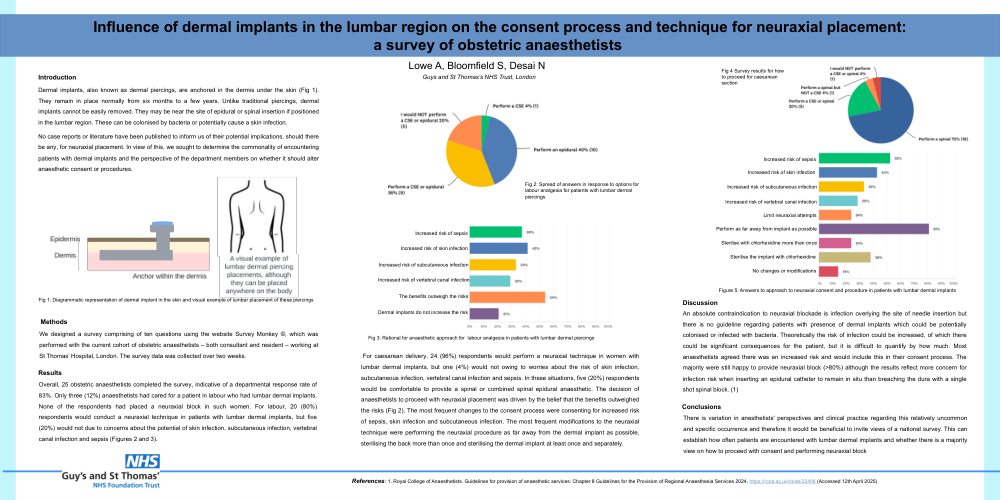
Dermal implants, also known as dermal piercings, are anchored in the dermis under the skin (Fig 1). They remain in place normally from six months to a few years. Unlike traditional piercings, dermal implants cannot be easily removed. They may be near the site of epidural or spinal insertion if positioned in the lumbar region. These can be colonised by bacteria or potentially cause a skin infection.
No case reports or literature have been published to inform us of their potential implications, should there be any, for neuraxial placement. In view of this, we sought to determine the commonality of encountering patients with dermal implants and the perspective of the department members on whether it should alter anaesthetic consent or procedures.
Methods
We designed a survey comprising of ten questions using the website Survey Monkey ©, which was performed with the current cohort of obstetric anaesthetists – both consultant and resident – working at St Thomas’ Hospital, London. The survey data was collected over two weeks.
Results
Overall, 25 obstetric anaesthetists completed the survey, indicative of a departmental response rate of 83%. Only three (12%) anaesthetists had cared for a patient in labour who had lumbar dermal implants. None of the respondents had placed a neuraxial block in such women. For labour, 20 (80%) respondents would conduct a neuraxial technique in patients with lumbar dermal implants, but five (20%) would not due to concerns about the potential of skin infection, subcutaneous infection, vertebral canal infection and sepsis (Figures 2 and 3).
For caesarean delivery, 24 (96%) respondents would perform a neuraxial technique in women with lumbar dermal implants, but one (4%) would not owing to worries about the risk of skin infection, subcutaneous infection, vertebral canal infection and sepsis. In these situations, five (20%) respondents would be comfortable to provide a spinal or combined spinal epidural anaesthetic. The decision of anaesthetists to proceed with neuraxial placement was driven by the belief that the benefits outweighed the risks (Fig 2). The most frequent changes to the consent process were consenting for increased risk of sepsis, skin infection and subcutaneous infection. The most frequent modifications to the neuraxial technique were performing the neuraxial procedure as far away from the dermal implant as possible, sterilising the back more than once and sterilising the dermal implant at least once and separately.
Discussion
An absolute contraindication to neuraxial blockade is infection overlying the site of needle insertion but there is no guideline regarding patients with presence of dermal implants which could be potentially
colonised or infected with bacteria. Theoretically the risk of infection could be increased, of which there could be significant consequences for the patient, but it is difficult to quantify by how much. Most anaesthetists agreed there was an increased risk and would include this in their consent process. The majority were still happy to provide neuraxial block (>80%) although the results reflect more concern for infection risk when inserting an epidural catheter to remain in situ than breaching the dura with a single shot spinal block. (1)
Conclusions
There is variation in anesthetists' perspectives and clinical practice regarding this relatively uncommon and specific occurrence and therefore it would be beneficial to invite views of a national survey. This can establish how often patients are encountered with lumbar dermal implants and whether there is a majority view on how to proceed with consent and performing neuraxial block