215 posters, 5 topics, 22 sessions, 596 authors, 283 institutions
ePostersLive by SciGen Technologies S.A. All rights reserved.
Obstetric Anaesthesia Annual Scientific Meeting 2025
May 15 - 16, 2025 | ICC, 2 Lanyon Place, Belfast BT1 3WH

6780444
Enhancing multi-disciplinary readiness for perinatal haemorrhage in a unique case involving ultra-rare anti-GIL antibodies.
Poster Presenter
Part of Topic
Case report
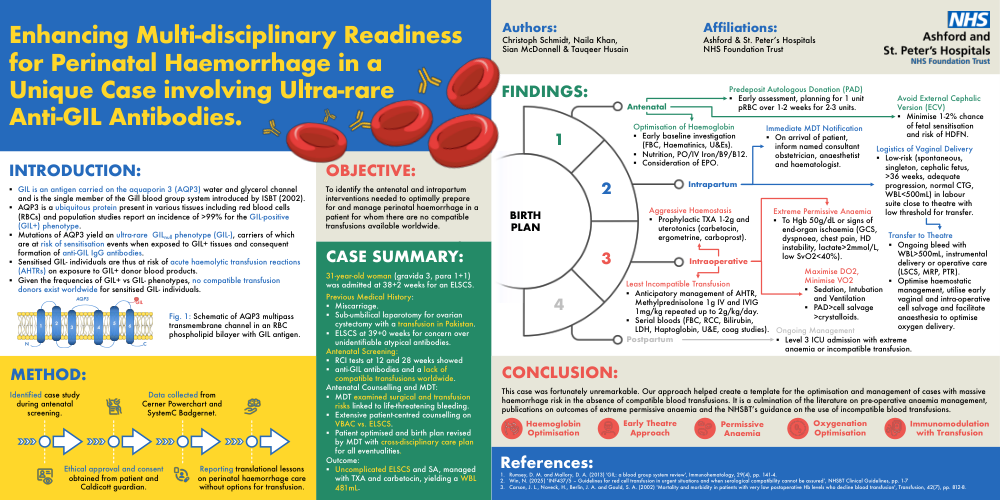
Enhancing Multi-disciplinary Readiness for Perinatal Haemorrhage in a Unique Case involving Ultra-rare Anti-GIL Antibodies.
Introduction:
- GIL is an antigen carried on the aquaporin 3 (AQP3) water and glycerol channel and is the single member of the Gill blood group system introduced by ISBT (2002).
- AQP3 is a ubiquitous protein present in various tissues including red blood cells (RBCs) and population studies report an incidence of >99% for the GIL-positive (GIL+) phenotype.
- Mutations of AQP3 yield an ultra-rare GILnull phenotype (GIL-), carriers of which are at risk of sensitisation events when exposed to GIL+ tissues and consequent formation of anti-GIL IgG antibodies.
- Sensitised GIL- individuals are thus at risk of acute haemolytic transfusion reactions (AHTRs) on exposure to GIL+ donor blood products.
- Given the frequencies of GIL+ vs GIL- phenotypes, no compatible transfusion donors exist worldwide for sensitised GIL- individuals.
Objective:
- To identify the antenatal and intrapartum interventions needed to optimally prepare for and manage perinatal haemorrhage in a patient for whom there are no compatible transfusions available worldwide.
Conclusion:
- This case was fortunately unremarkable. Our approach helped create a template for the optimisation and management of cases with massive haemorrhage risk in the absence of compatible blood transfusions. It is a culmination of the literature on pre-operative anaemia management, publications on outcomes of extreme permissive anaemia and the NHSBT’s guidance on the use of incompatible blood transfusions.