215 posters, 5 topics, 22 sessions, 596 authors, 283 institutions
ePostersLive by SciGen Technologies S.A. All rights reserved.
Obstetric Anaesthesia Annual Scientific Meeting 2025
May 15 - 16, 2025 | ICC, 2 Lanyon Place, Belfast BT1 3WH

6780401
Pulmonary hypertension: A strategy for dealing with the pressures and failures in the obstetric environment
Poster Presenter
Part of Topic
Case report
Introduction
•Cardiac disease is a leading cause of maternal death.
•Pulmonary hypertension (PH) accounts for only one percent of cardiac cases in pregnancy.
•However, it remains a high-risk condition associated with maternal mortality rates of 10-33% and increased foetal/neonatal morbidity and mortality [1].
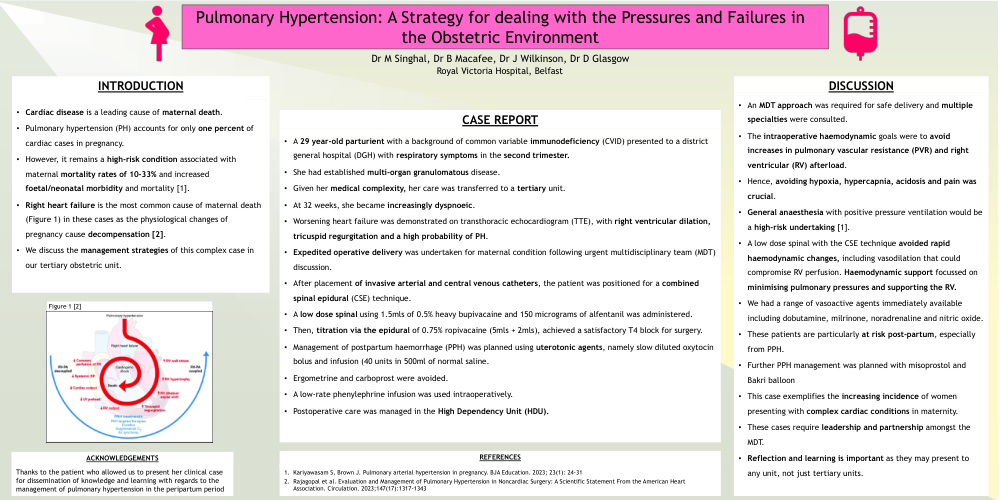
•Right heart failure is the most common cause of maternal death (Figure 1) in these cases as the physiological changes of pregnancy cause decompensation [2].
•We discuss the management strategies of this complex case in our tertiary obstetric unit.
Case Report
•A 29 year-old parturient with a background of common variable immunodeficiency (CVID) presented to a district general hospital (DGH) with respiratory symptoms in the second trimester.
•She had established multi-organ granulomatous disease.
•Given her medical complexity, her care was transferred to a tertiary unit.
•At 32 weeks, she became increasingly dyspnoeic.
•Worsening heart failure was demonstrated on transthoracic echocardiogram (TTE), with right ventricular dilation, tricuspid regurgitation and a high probability of PH.
•Expedited operative delivery was undertaken for maternal condition following urgent multidisciplinary team (MDT) discussion.
•After placement of invasive arterial and central venous catheters, the patient was positioned for a combined spinal epidural (CSE) technique.
•A low dose spinal using 1.5mls of 0.5% heavy bupivacaine and 150 micrograms of alfentanil was administered.
•Then, titration via the epidural of 0.75% ropivacaine (5mls + 2mls), achieved a satisfactory T4 block for surgery.
•Management of postpartum haemorrhage (PPH) was planned using uterotonic agents, namely slow diluted oxytocin bolus and infusion (40 units in 500ml of normal saline.
•Ergometrine and carboprost were avoided.
•A low-rate phenylephrine infusion was used intraoperatively.
•Postoperative care was managed in the High Dependency Unit (HDU).
Discussion
•An MDT approach was required for safe delivery and multiple specialties were consulted.
•The intraoperative haemodynamic goals were to avoid increases in pulmonary vascular resistance (PVR) and right ventricular (RV) afterload.
•Hence, avoiding hypoxia, hypercapnia, acidosis and pain was crucial.
•General anaesthesia with positive pressure ventilation would be a high-risk undertaking [1].
•A low dose spinal with the CSE technique avoided rapid haemodynamic changes, including vasodilation that could compromise RV perfusion. Haemodynamic support focussed on minimising pulmonary pressures and supporting the RV.
•We had a range of vasoactive agents immediately available including dobutamine, milrinone, noradrenaline and nitric oxide.
•These patients are particularly at risk post-partum, especially from PPH.
•Further PPH management was planned with misoprostol and Bakri balloon
•This case exemplifies the increasing incidence of women presenting with complex cardiac conditions in maternity.
•These cases require leadership and partnership amongst the MDT.
•Reflection and learning is important as they may present to any unit, not just tertiary units.
References
1.Kariyawasam S, Brown J. Pulmonary arterial hypertension in pregnancy. BJA Education. 2023; 23(1): 24-31
2.Rajagopal et al. Evaluation and Management of Pulmonary Hypertension in Noncardiac Surgery: A Scientific Statement From the American Heart Association. Circulation. 2023;147(17):1317-1343