215 posters, 5 topics, 22 sessions, 596 authors, 283 institutions
ePostersLive by SciGen Technologies S.A. All rights reserved.
Obstetric Anaesthesia Annual Scientific Meeting 2025
May 15 - 16, 2025 | ICC, 2 Lanyon Place, Belfast BT1 3WH

6780284
Airway assessment in a tertiary obstetric centre: a survey of opinion
Poster Presenter
Authors
Affiliations
Part of Topic
Surveys
Airway Assessment in a Tertiary Obstetric Centre: A Survey of Opinion
Dr Claire Connell (CT2), Dr Ross Spy (ST6) and Dr Rachel Darling (Consultant Anaesthetist), Queen Elizabeth University Hospital, Glasgow
INTRODUCTION
Although the use of general anaesthesia in obstetrics has declined, the risk of failed intubation is higher compared to the general population (1). Joint guidelines from the Difficult Airway Society and Obstetric Anaesthetists’ Association emphasise the importance of conducting a thorough airway assessment for obstetric patients, with clear documentation in patient notes (2). A recent audit in Queen Elizabeth University Hospital, Glasgow demonstrated that airway assessment is poorly documented in our labour ward.
METHODS
An online qualitative survey was developed to examine variations in current practice and explore opinion regarding airway assessment in the obstetric population. All anaesthetists in our institution were invited to participate over a 90 day period in 2024. The project was registered with the local quality improvement directory.
RESULTS
57 anaesthetists responded (21 Consultants, 36 Anaesthetic Residents).
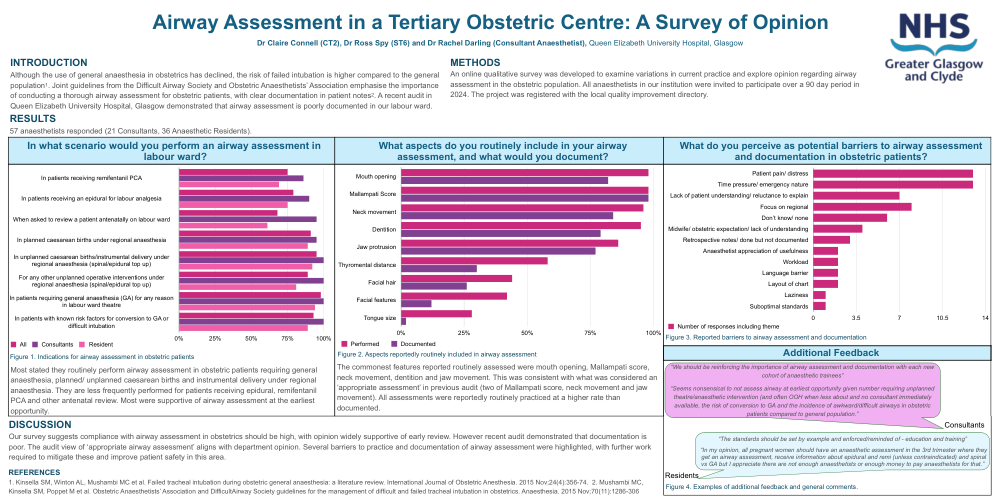
Most stated they routinely perform airway assessment in obstetric patients requiring general anaesthesia, planned/ unplanned caesarean births and instrumental delivery under regional anaesthesia. They are less frequently performed for patients receiving epidural, remifentanil PCA and other antenatal review. Most were supportive of airway assessment at the earliest opportunity.
The commonest features reported routinely assessed were mouth opening, Mallampati score, neck movement, dentition and jaw movement. This was consistent with what was considered an ‘appropriate assessment’ in previous audit (two of Mallampati score, neck movement and jaw movement). All assessments were reportedly routinely practiced at a higher rate than documented.
Several potential barriers to airway assessment and documentation were identified.
DISCUSSION
Our survey suggests compliance with airway assessment in obstetrics should be high, with opinion widely supportive of early review. However recent audit demonstrated that documentation is poor. The audit view of ‘appropriate airway assessment’ aligns with department opinion. Several barriers to practice and documentation of airway assessment were highlighted, with further work required to mitigate these and improve patient safety in this area.
REFERENCES
1. Kinsella SM, Winton AL, Mushambi MC et al. Failed tracheal intubation during obstetric general anaesthesia: a literature review. International Journal of Obstetric Anesthesia. 2015 Nov;24(4):356-74.
2. Mushambi MC, Kinsella SM, Poppet M et al. Obstetric Anaesthetists’ Association and DifficultAirway Society guidelines for the management of difficult and failed tracheal intubation in obstetrics. Anaesthesia. 2015 Nov;70(11):1286-306