215 posters, 5 topics, 22 sessions, 596 authors, 283 institutions
ePostersLive by SciGen Technologies S.A. All rights reserved.
Obstetric Anaesthesia Annual Scientific Meeting 2025
May 15 - 16, 2025 | ICC, 2 Lanyon Place, Belfast BT1 3WH

6780183
Flashcard Team Training: Facilitating learning in a busy working day
Poster Presenter
Authors
Affiliations
Part of Topic
Surveys
Flashcard Team Training; Facilitating Learning in a Busy Working Day
Dr Tim Durkan, Dr Aoife Deeny, Dr Ciara Armstrong, Dr Rachel Mathers
Introduction
Multiple sources including the Royal College of Anaesthestists, the Association of Medical Education and the Ockenden Report have published reports highlighting the importance of the concept that those working together, should train together (1,2). Additionally, Chapter 9 of the Guidelines for the Provision of Anaesthetic Services, details specific guidelines for the obstetric population and state that in-situ simulation training can help to identify system process gaps (3).
As anaesthetists we know that the provision of safe obstetric care inherently involves a wide variety of staff in a multi-disciplinary team. It is imperative that this multifunctional team is able to work efficiently during emergency situations. In order to do this, it is essential that regular team training takes place to familiarise the team and to identify any system process gaps. We identified that the challenge in achieving this is finding the time and space to facilitate training in order to achieve best practice for patients.
Methodology
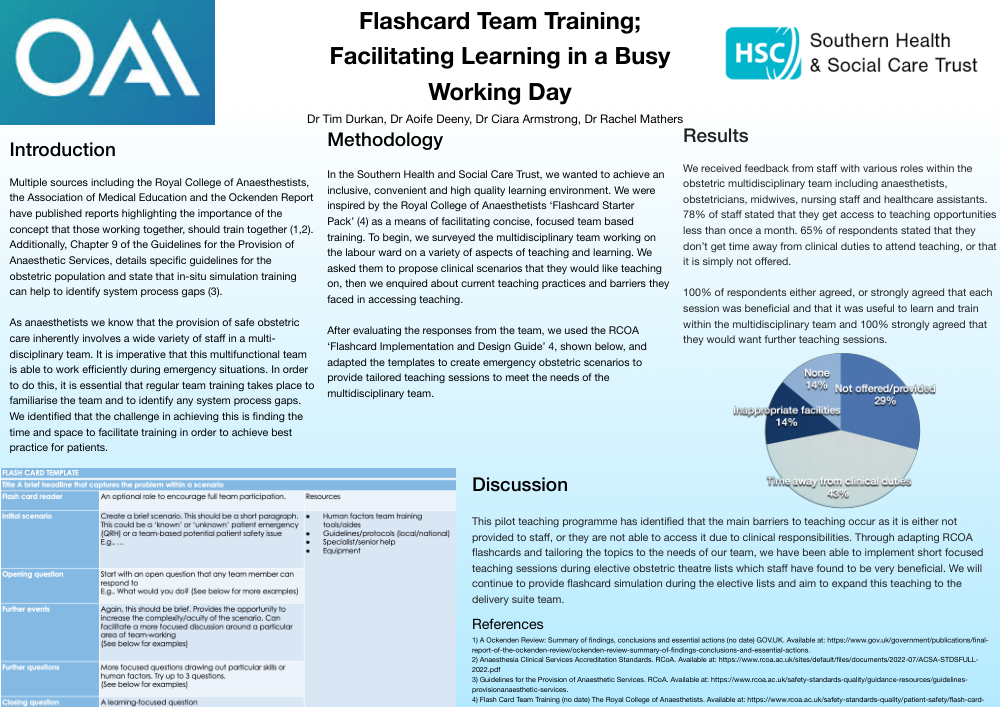
In the Southern Health and Social Care Trust, we wanted to achieve an inclusive, convenient and high quality learning environment. We were inspired by the Royal College of Anaesthetists ‘Flashcard Starter Pack’ (4) as a means of facilitating concise, focused team based training. To begin, we surveyed the multidisciplinary team working on the labour ward on a variety of aspects of teaching and learning. We asked them to propose clinical scenarios that they would like teaching on, then we enquired about current teaching practices and barriers they faced in accessing teaching.
After evaluating the responses from the team, we used the RCOA ‘Flashcard Implementation and Design Guide’ 4, shown below, and adapted the templates to create emergency obstetric scenarios to provide tailored teaching sessions to meet the needs of the multidisciplinary team.
Results
We received feedback from staff with various roles within the obstetric multidisciplinary team including anaesthetists, obstetricians, midwives, nursing staff and healthcare assistants. 78% of staff stated that they get access to teaching opportunities less than once a month. 65% of respondents stated that they don’t get time away from clinical duties to attend teaching, or that it is simply not offered.
100% of respondents either agreed, or strongly agreed that each session was beneficial and that it was useful to learn and train within the multidisciplinary team and 100% strongly agreed that they would want further teaching sessions.
Discussion
This pilot teaching programme has identified that the main barriers to teaching occur as it is either not provided to staff, or they are not able to access it due to clinical responsibilities. Through adapting RCOA flashcards and tailoring the topics to the needs of our team, we have been able to implement short focused teaching sessions during elective obstetric theatre lists which staff have found to be very beneficial. We will continue to provide flashcard simulation during the elective lists and aim to expand this teaching to the delivery suite team.