215 posters, 5 topics, 22 sessions, 596 authors, 283 institutions
ePostersLive by SciGen Technologies S.A. All rights reserved.
Obstetric Anaesthesia Annual Scientific Meeting 2025
May 15 - 16, 2025 | ICC, 2 Lanyon Place, Belfast BT1 3WH

6780151
Cardiac complications in a pregnant patient with rheumatic valve disease: a cautionary tale
Poster Presenter
Authors
Affiliations
Part of Topic
Case report
Title: Cardiac complications in a pregnant patient with rheumatic valve disease: a cautionary tale
Introduction: Pregnancy poses a risk for patients with valvular heart disease: 20-25% risk of heart failure with moderate to severe mitral regurgitation and 30-50% risk with mitral stenosis.1 All patients with significant mitral stenosis should be counselled against pregnancy and intervention pre-pregnancy is favoured, even if asymptomatic.1 This case highlights learning points relating to valvular disease in pregnancy. Written consent obtained for presentation.
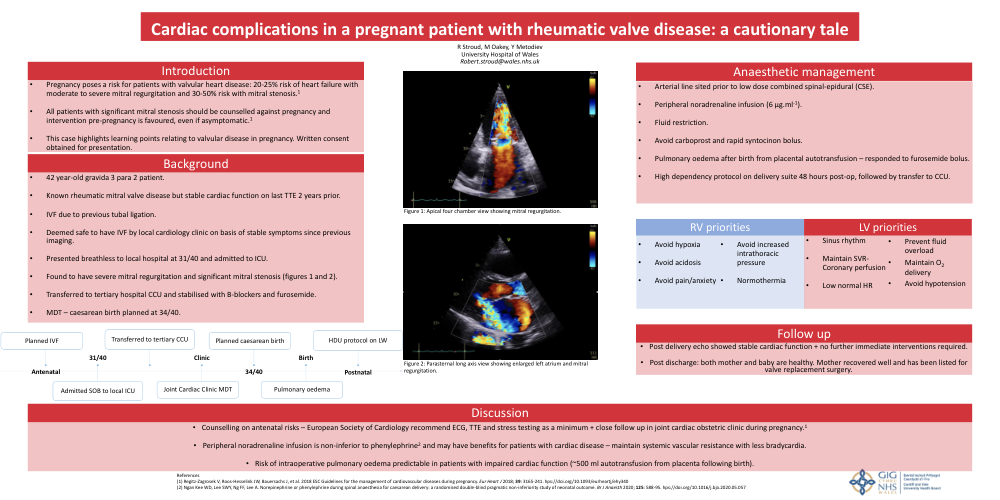
Background: 42 year-old gravida 3 para 2 patient. Known rheumatic mitral valve disease but stable cardiac function on last TTE 2 years prior. IVF due to previous tubal ligation. Deemed safe to have IVF by local cardiology clinic on basis of stable symptoms since previous imaging. Presented breathless to local hospital at 31/40 and admitted to ICU. Found to have severe mitral regurgitation and significant mitral stenosis (figures 1 and 2). Transferred to tertiary hospital CCU and stabilised with B-blockers and furosemide. MDT – caesarean birth planned at 34/40.
Anaesthetic management: Arterial line sited prior to low dose combined spinal-epidural (CSE). Peripheral noradrenaline infusion (6 μg.ml-1). Fluid restriction. Avoid carboprost and rapid syntocinon bolus. Pulmonary oedema after birth from placental autotransfusion – responded to furosemide bolus. High dependency protocol on delivery suite 48 hours post-op, followed by transfer to CCU.
Follow up: post delivery echo showed stable cardiac function + no further immediate interventions required. Post discharge: both mother and baby are healthy. Mother recovered well and has been listed for valve replacement surgery.
Discussion: Counselling on antenatal risks – European Society of Cardiology recommend ECG, TTE and stress testing as a minimum + close follow up in joint cardiac obstetric clinic during pregnancy.1 Peripheral noradrenaline infusion is non-inferior to phenylephrine2 and may have benefits for patients with cardiac disease – maintain systemic vascular resistance with less bradycardia. Risk of intraoperative pulmonary oedema predictable in patients with impaired cardiac function (~500 ml autotransfusion from placenta following birth).