215 posters, 5 topics, 22 sessions, 596 authors, 283 institutions
ePostersLive by SciGen Technologies S.A. All rights reserved.
Obstetric Anaesthesia Annual Scientific Meeting 2025
May 15 - 16, 2025 | ICC, 2 Lanyon Place, Belfast BT1 3WH

6780143
A postpartum presentation of acute fatty liver disease of pregnancy
Poster Presenter
Part of Topic
Case report
Introduction
Acute fatty liver of pregnancy (AFLP) is a rare but significant complication of pregnancy due to its association with high maternal mortality. Perinatal mortality has been reported as being as high as 20-50%1. It was first described by Sheehan in 1940 and is characterised by microvesicular steatosis of the liver2. If not diagnosed and treated promptly, usually with an intensive care admission, AFLP can lead to rapidly developing multi organ dysfunction. We present a case of a 41 year old woman pregnant with male DCDA twins who required intensive care admission after rapid development of liver and renal failure.
Case Report
A 41 year old primip attended hospital reporting reduced foetal movements. She was pregnant with DCDA twin boys conceived via IVF. She had no significant past medical history.
The patient reported a 10 day history of bilateral pedal oedema and a one week history of lethargy and lack of appetite prior to her admission. Her blood pressure had been within normal limits. On arrival at hospital a CTG revealed foetal distress. A category one caesarean section was performed under general anaesthetic. The caesarean proceeded without complication and two live babies were delivered. Post operative recovery was seemingly unremarkable and the patient was transferred to the postnatal ward.
The following morning the woman was reported to be drowsy and mildly confused on the ward. She had an episode of hypoglycaemia with a blood glucose level of 1. She also developed pyrexia with a temperature of 38.5. Management with antibiotics and glucose was initiated and she was transferred back to the labour ward for review.
On examination the woman was somnolent but rousable. Her observations were heart rate 114, blood pressure of 101/67, sats 99% on 2L of oxygen. She was afebrile on admission. Her GCS was 14 and she was mildly confused but oriented to time, place and person. She had a liver flap present and was icteric. Her abdomen was soft and with mild tenderness. No hepatomegaly or ascites were noted. She had mild oedema bilaterally in both legs.
Given the rapidly developing liver dysfunction and renal failure, transfer to the intensive care unit was arranged. She was resuscitated with IV Sodium chloride 0.9% and strict fluid balance monitoring was commenced. She was commenced on tazocin and fluconazole. She was given a 3 day course of vitamin K. She was also given lactulose for management of the developing encephalopathy.
On admission to ICU she was commenced on continuous veno-venous haemodialysis immediately, due to the concerns of developing cerebral oedema and consequent herniation. Her admission was complicated by a diagnosis of disseminated intravascular coagulation and a possibly secondary diagnosis of pre eclampsia which was treated with magnesium and nifedipine. She was successfully discharged back to labour ward after 8 days of admission and later discharged home.
Discussion
Acute fatty liver of pregnancy is a rare condition that impacts about 5 in 100,000 pregnancies3. Due to a combination of the rarity of the presentation and the speed at which organ dysfunction can develop it is imperative that it is rapidly recognised and appropriately treated. Intensive care involvement should be sort as quickly as possible.
There is an increase in the serum level of fatty acids in the serum of pregnant women secondary to the decreased oxidation of long and medium chain fatty acids4. High volumes of free fatty acids can act as hepatotoxins in vulnerable patients. Fatty acids can infiltrate the liver and impair its function, resulting in reduced production of cholesterol, fibrinogen and coagulation factors. In addition, bilirubin conjugation and clearance is impaired. Kidney impairment can also be due to infiltration from fatty acids. However, it is most likely to be caused by the hypoperfusion secondary to hypotension or the development of hepatorenal syndrome. Foetal distress can also be as a result of fatty acid infiltration to the placenta causing hypoperfusion and hypoxia.
The prodromal symptoms of acute fatty liver of pregnancy are often vague. Women are at risk at above 30 weeks gestation. Women often report malaise, anorexia and fatigue initially. They then develop more specific symptoms of liver disease such as abdominal pain, nausea and vomiting, jaundice, icterus, pruritus and oedema. Ultimately the patient can develop hepatic encephalopathy with asterixis and ascites.
A full set of laboratory tests are required when acute fatty liver disease of pregnancy is suspected. Liver function tests will reveal a raised bilirubin, elevated transaminases and gamma-glutamyl transpeptidase. Patients may also have leukocytosis, raised INR and raised ammonia. As was with this patient, renal function tests can be deranged with a raised urea and creatinine.
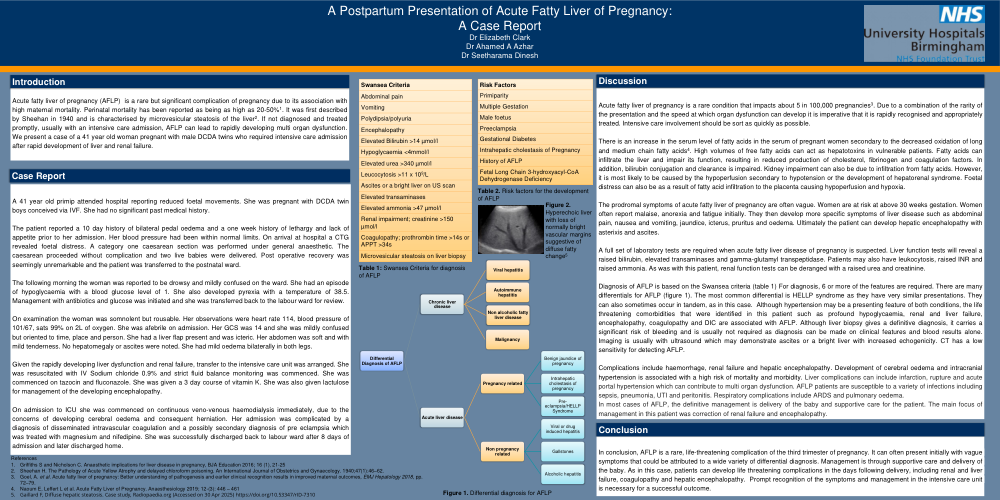
Diagnosis of AFLP is based on the Swansea criteria (table 1) For diagnosis, 6 or more of the features are required. There are many differentials for AFLP (figure 1). The most common differential is HELLP syndrome as they have very similar presentations. They can also sometimes occur in tandem, as in this case. Although hypertension may be a presenting feature of both conditions, the life threatening comorbidities that were identified in this patient such as profound hypoglycaemia, renal and liver failure, encephalopathy, coagulopathy and DIC are associated with AFLP. Although liver biopsy gives a definitive diagnosis, it carries a significant risk of bleeding and is usually not required as diagnosis can be made on clinical features and blood results alone. Imaging is usually with ultrasound which may demonstrate ascites or a bright liver with increased echogenicity. CT has a low sensitivity for detecting AFLP.
Complications include haemorrhage, renal failure and hepatic encephalopathy. Development of cerebral oedema and intracranial hypertension is associated with a high risk of mortality and morbidity. Liver complications can include infarction, rupture and acute portal hypertension which can contribute to multi organ dysfunction. AFLP patients are susceptible to a variety of infections including sepsis, pneumonia, UTI and peritonitis. Respiratory complications include ARDS and pulmonary oedema.
In most cases of AFLP, the definitive management is delivery of the baby and supportive care for the patient. The main focus of management in this patient was correction of renal failure and encephalopathy.
Conclusion
In conclusion, AFLP is a rare, life-threatening complication of the third trimester of pregnancy. It can often present initially with vague symptoms that could be attributed to a wide variety of differential diagnosis. Management is through supportive care and delivery of the baby. As in this case, patients can develop life threatening complications in the days following delivery, including renal and liver failure, coagulopathy and hepatic encephalopathy. Prompt recognition of the symptoms and management in the intensive care unit is necessary for a successful outcome.