215 posters, 5 topics, 22 sessions, 596 authors, 283 institutions
ePostersLive by SciGen Technologies S.A. All rights reserved.
Obstetric Anaesthesia Annual Scientific Meeting 2025
May 15 - 16, 2025 | ICC, 2 Lanyon Place, Belfast BT1 3WH

6780058
Walking on a tight rope: Anaesthetic Management of a Patient with Vascular Ehlers-Danlos Syndrome for an Elective Caesarean Section
Poster Presenter
Authors
Affiliations
Part of Topic
Case report
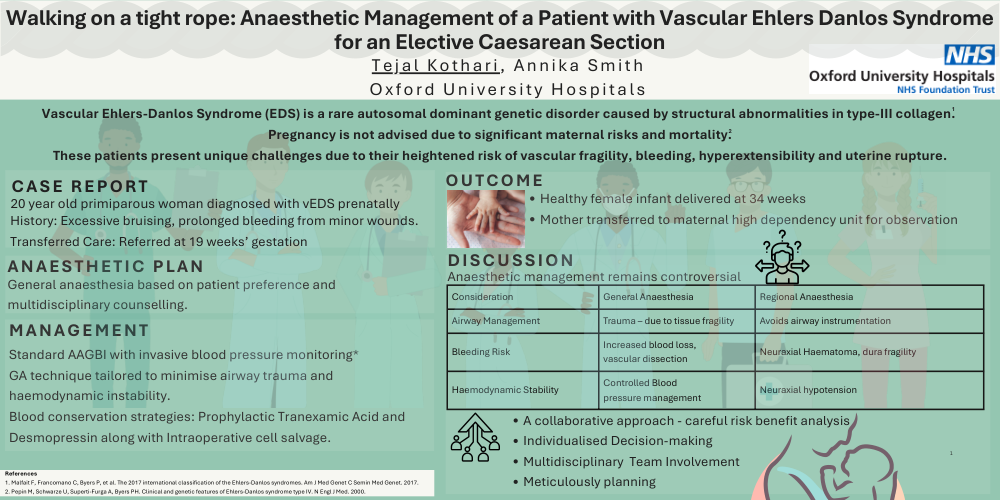
Walking on a tight rope: Anaesthetic Management of a Patient with Vascular Ehlers Danlos Syndrome for an Elective Caesarean Section
Vascular Ehlers-Danlos Syndrome (EDS) is a rare autosomal dominant genetic disorder caused by structural abnormalities in type-III collagen.
Pregnancy is not advised due to significant maternal risks and mortality.
These patients present unique challenges due to their heightened risk of vascular fragility, bleeding, hyperextensibility and uterine rupture.
C A S E R E P O R T
20 year old primiparous woman diagnosed with vEDS prenatally
History: Excessive bruising, prolonged bleeding from minor wounds.
Transferred Care: Referred at 19 weeks’ gestation
A N A E S T H E T I C P L A N
General anaesthesia based on patient preference and multidisciplinary counselling.
M A N A G E M E N T
Standard AAGBI with invasive blood pressure monitoring*
GA technique tailored to minimise airway trauma and haemodynamic instability.
Blood conservation strategies: Prophylactic Tranexamic Acid and Desmopressin along with Intraoperative cell salvage.
GA vs RA
Bleeding Risk, Increased blood loss, vascular dissection
Neuraxial Haematoma, dura fragility
Haemodynamic Stability
Controlled Blood pressure management
Neuraxial hypotension
O U T C O M E
Healthy female infant delivered at 34 weeks
Mother transferred to maternal high dependency unit for observation
D I S C U S S I O N
Anaesthetic management remains controversial
Consideration General Anaesthesia Regional Anaesthesia
Airway Management Trauma – due to tissue fragility Avoids airway instrumentation
A collaborative approach - careful risk benefit analysis
Individualised Decision-making
Multidisciplinary Team Involvement
Meticulously planning
References
1. Malfait F, Francomano C, Byers P, et al. The 2017 international classification of the Ehlers-Danlos syndromes. Am J Med Genet C Semin Med Genet. 2017.
2. Pepin M, Schwarze U, Superti-Furga A, Byers PH. Clinical and genetic features of Ehlers-Danlos syndrome type IV. N Engl J Med. 2000.