215 posters, 5 topics, 22 sessions, 596 authors, 283 institutions
ePostersLive by SciGen Technologies S.A. All rights reserved.
Obstetric Anaesthesia Annual Scientific Meeting 2025
May 15 - 16, 2025 | ICC, 2 Lanyon Place, Belfast BT1 3WH

6780038
Hypertension, end organ damage, and coma caused by PTHrP-associated hypercalcaemia in a term pregnancy
Poster Presenter
Part of Topic
Case report
Hypertension, end organ damage and coma caused by PTHrP-associated hypercalcaemia in a term pregnancy
Sebastian Calloway, Aidan Melia, Luke Staveley-Wadham, Jennifer Blackman, George Graham, Francesca Poole, Max Coupe-King
Royal Devon University Healthcare NHS Foundation Trust
Introduction
Hypercalcemia in pregnancy is uncommon but can increase maternal and foetal mortality. Causes include primary hyperparathyroidism, milk-alkali syndrome and humoral hypercalcaemia of malignancy caused by parathyroid hormone related protein (PTHrP) release.1
The placenta and mammary glands normally secrete PTHrP during pregnancy and lactation. Excessive PTHrP release from mammary hyperplasia, fibroids or the placenta is typically mild, with very few cases of hypercalcaemic crisis reported.
We describe what we believe to be the first case of hypercalcaemic crisis from excessive PTHrP production so severe so as to require intubation, with the highest plasma calcium level secondary to placental PTHrP yet reported in literature.
Case
Labour Ward and Theatre
A 40 year old woman with known fibroids presented at 39 weeks gestation for an elective caesarean section. Preoperatively she developed acute hypertension, headache, acute kidney injury, proteinuria and hypokalaemia (2.8mmol/L). A provisional diagnosis of pre-eclampsia was made. She was initially managed with oral labetalol, but progressed to a category one caesarean section under xxx anaesthetic due to cardiotocography concerns.
She was referred to critical care post operatively for insertion of a central venous catheter to deliver concentrated potassium replacement.
Intensive Care
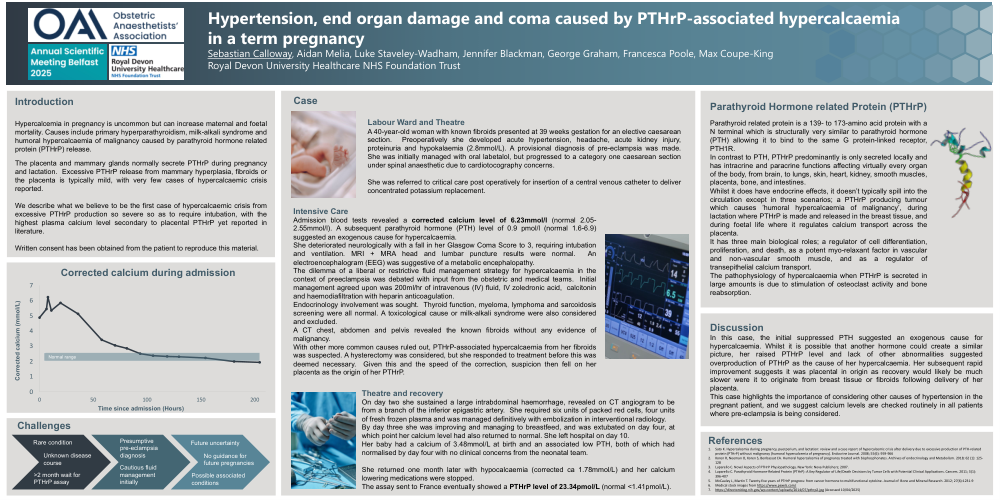
Admission blood tests revealed a corrected calcium level of 6.23mmol/l (normal 2.05-2.55mmol/l). A subsequent parathyroid hormone (PTH) level of 0.9 pmol/l (normal 1.6-6.9) suggested an exogenous cause for hypercalcaemia.
She deteriorated neurologically with a fall in her Glasgow Coma Score to xxx, requiring intubation and ventilation. MRI + MRA head and lumbar puncture results were normal. An electroencephalogram (EEG) was suggestive of a metabolic encephalopathy.
The dilemma of a liberal or restrictive fluid management strategy for hypercalcaemia in the context of preeclampsia was considered with input from the obstetric and medical teams. Initial management agreed upon was 200ml/hr of intravenous (IV) fluid, IV zoledronic acid, calcitonin and haemodiafiltration with heparin anticoagulation.
Endocrinology involvement was sought. Thyroid function, myeloma, lymphoma and sarcoidosis screening were all normal. A toxicological cause or milk-alkali syndrome were also considered and excluded.
A CT chest, abdomen and pelvis revealed the known fibroids without any evidence of malignancy.
With other more common causes ruled out, PTHrP-associated hypercalcaemia from her fibroids was suspected. A hysterectomy was considered, but she responded to treatment before this was deemed necessary. Given this and the speed of the correction, suspicion then fell on her placenta as the origin of her PTHrP.
Theatre and recovery
On day two she sustained a large intrabdominal haemorrhage, revealed on CT angiogram to be from a branch of the inferior epigastric artery. She required a large volume of blood product resuscitation and was managed definitively with embolization in interventional radiology.
By day three she was improving and managing to breastfeed, and was extubated on day four, at which point her calcium level had also returned to normal. She left hospital on day 10.
Her baby had a calcium of 3.48mmol/L at birth and an associated low PTH, both of which had normalised by day four with no clinical concerns from the neonatal team.
She returned one month later with hypocalcaemia (corrected ca 1.78mmol/L) and her calcium lowering medications were stopped.
The assay sent to France eventually showed a PTHrP level of 23.34pmol/L (normal <1.41pmol/L).
Parathyroid Hormone related Protein (PTHrP)
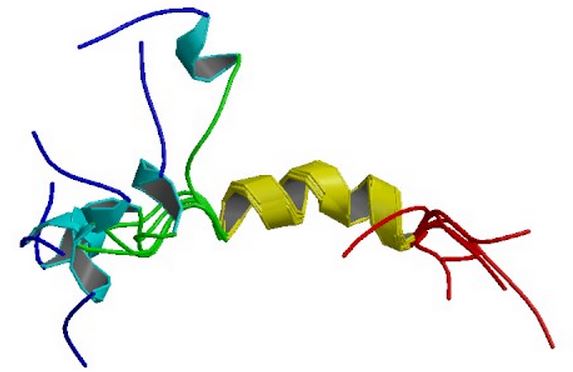
Parathyroid related protein is a 139- to 173-amino acid protein with a N terminal which is structurally very similar to parathyroid hormone (PTH) allowing it to bind to the same G protein-linked receptor, PTH1R.
In contrast to PTH, PTHrP predominantly is only secreted locally and has intracrine and paracrine functions affecting virtually every organ of the body, from brain, to lungs, skin, heart, kidney, smooth muscles, placenta, bone, and intestines.
Whilst it does have endocrine effects, it doesn’t typically spill into the circulation except in three scenarios; a PTHrP producing tumour which causes ’humoral hypercalcaemia of malignancy’, during lactation where PTHrP is made and released in the breast tissue, and during foetal life where it regulates calcium transport across the placenta.
It has three main biological roles; a regulator of cell differentiation, proliferation, and death, as a potent myo-relaxant factor in vascular and non-vascular smooth muscle, and as a regulator of transepithelial calcium transport.
The pathophysiology of hypercalcaemia when PTHrP is secreted in large amounts is due to stimulation of osteoclast activity and bone reabsorption.
Discussion
In this case, the initial suppressed PTH suggested an exogenous cause for hypercalcaemia. Whilst it is possible that another hormone could create a similar picture, her raised PTHrP level and lack of other abnormalities suggested overproduction of PTHrP as the cause of her hypercalcaemia. Her subsequent rapid improvement suggests it was placental in origin as recovery would likely be much slower were it to originate from breast tissue or fibroids following delivery of her placenta.
This case highlights the importance of considering other causes of hypertension in the pregnant patient, and we suggest calcium levels are checked routinely in all patients where pre-eclampsia is being considered.
References