215 posters, 5 topics, 22 sessions, 596 authors, 283 institutions
ePostersLive by SciGen Technologies S.A. All rights reserved.
Obstetric Anaesthesia Annual Scientific Meeting 2025
May 15 - 16, 2025 | ICC, 2 Lanyon Place, Belfast BT1 3WH

6779981
A case report of Mirror Syndrome secondary to Toxoplasmosis infection
Poster Presenter
Authors
Affiliations
Part of Topic
Case report
A case report of Mirror Syndrome secondary to Toxoplasmosis infection
E. Thomas1 and K. Chapman2
1 ST6 Anaesthetics, Royal Devon and Exeter Hospital, Exeter, Devon, UK, 2 Consultant Anaesthetist, Derriford Hospital, Plymouth, Devon, UK
Introduction
We report a case of Mirror Syndrome, in a patient treated for Toxoplasmosis. Written consent was obtained from the patient to present this case.
Case Report
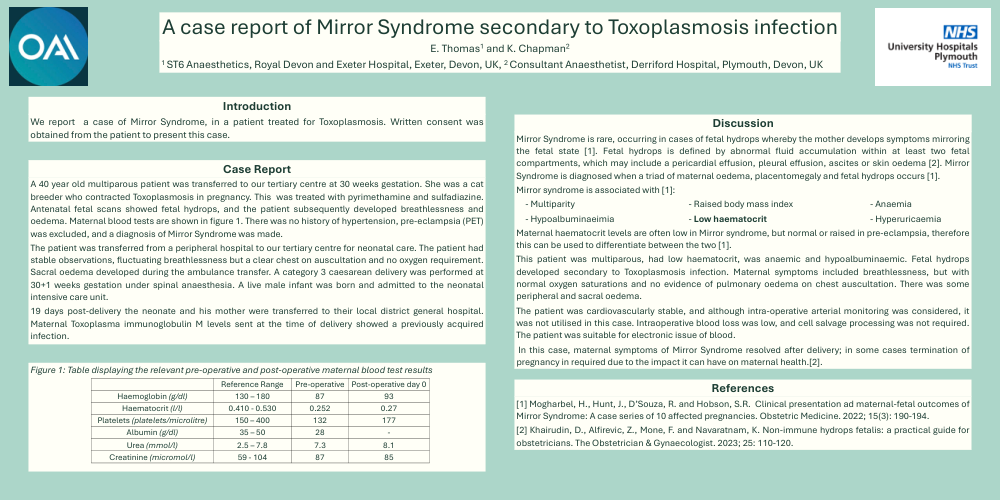
A 40 year old multiparous patient was transferred to our tertiary centre at 30 weeks gestation. She was a cat breeder who contracted Toxoplasmosis in pregnancy. This was treated with pyrimethamine and sulfadiazine. Antenatal fetal scans showed fetal hydrops, and the patient subsequently developed breathlessness and oedema. Maternal blood tests are shown in figure 1. There was no history of hypertension, pre-eclampsia (PET) was excluded, and a diagnosis of Mirror Syndrome was made.
The patient was transferred from a peripheral hospital to our tertiary centre for neonatal care. The patient had stable observations, fluctuating breathlessness but a clear chest on auscultation and no oxygen requirement. Sacral oedema developed during the ambulance transfer. A category 3 caesarean delivery was performed at 30+1 weeks gestation under spinal anaesthesia. A live male infant was born and admitted to the neonatal intensive care unit.
19 days post-delivery the neonate and his mother were transferred to their local district general hospital. Maternal Toxoplasma immunoglobulin M levels sent at the time of delivery showed a previously acquired infection.
Discussion
Mirror Syndrome is rare, occurring in cases of fetal hydrops whereby the mother develops symptoms mirroring the fetal state [1]. Fetal hydrops is defined by abnormal fluid accumulation within at least two fetal compartments, which may include a pericardial effusion, pleural effusion, ascites or skin oedema [2]. Mirror Syndrome is diagnosed when a triad of maternal oedema, placentomegaly and fetal hydrops occurs [1].
Mirror syndrome is associated with [1]:
- Multiparity - Raised body mass index - Anaemia
- Hypoalbuminaeimia - Low haematocrit - Hyperuricaemia
Maternal haematocrit levels are often low in Mirror syndrome, but normal or raised in pre-eclampsia, therefore this can be used to differentiate between the two [1].
This patient was multiparous, had low haematocrit, was anaemic and hypoalbuminaemic. Fetal hydrops developed secondary to Toxoplasmosis infection. Maternal symptoms included breathlessness, but with normal oxygen saturations and no evidence of pulmonary oedema on chest auscultation. There was some peripheral and sacral oedema.
The patient was cardiovascularly stable, and although intra-operative arterial monitoring was considered, it was not utilised in this case. Intraoperative blood loss was low, and cell salvage processing was not required. The patient was suitable for electronic issue of blood.
In this case, maternal symptoms of Mirror Syndrome resolved after delivery; in some cases termination of pregnancy in required due to the impact it can have on maternal health.[2].
References
[1] Mogharbel, H., Hunt, J., D’Souza, R. and Hobson, S.R. Clinical presentation ad maternal-fetal outcomes of Mirror Syndrome: A case series of 10 affected pregnancies. Obstetric Medicine. 2022; 15(3): 190-194.
[2] Khairudin, D., Alfirevic, Z., Mone, F. and Navaratnam, K. Non-immune hydrops fetalis: a practical guide for obstetricians. The Obstetrician & Gynaecologist. 2023; 25: 110-120.