215 posters, 5 topics, 22 sessions, 596 authors, 283 institutions
ePostersLive by SciGen Technologies S.A. All rights reserved.
Obstetric Anaesthesia Annual Scientific Meeting 2025
May 15 - 16, 2025 | ICC, 2 Lanyon Place, Belfast BT1 3WH

6779652
Magnetic resonance imaging in spinal pathology; can we improve maternal choice?
Poster Presenter
Authors
Affiliations
Part of Topic
Case report
MAGNETIC RESONANCE IMAGING IN SPINAL PATHOLOGY;
CAN WE IMPROVE MATERNAL CHOICE?
INTRODUCTION
•Neuraxial anaesthesia (NA) is the preferred anaesthetic technique for caesarean section (CS)
•Anaesthetists are increasingly being challenged with complex comorbidities including spinal pathologies and anatomical variations
•We present a case of the use of magnetic resonance imaging (MRI) in an antenatal patient presenting with significant lumbosacral swelling, who was denied NA for a previous CS
CASE REPORT
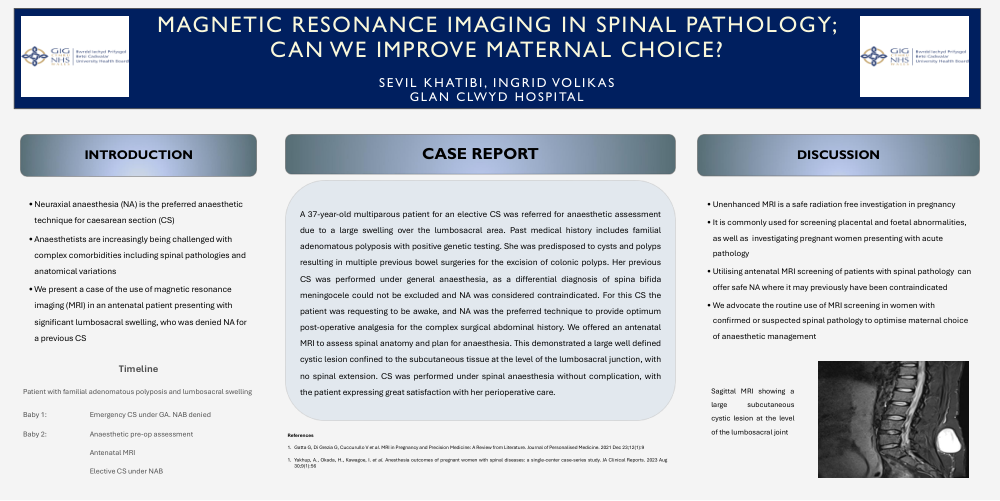
A 37-year-old multiparous patient for an elective CS was referred for anaesthetic assessment due to a large swelling over the lumbosacral area. Past medical history includes familial adenomatous polyposis with positive genetic testing. She was predisposed to cysts and polyps resulting in multiple previous bowel surgeries for the excision of colonic polyps. Her previous CS was performed under general anaesthesia, as a differential diagnosis of spina bifida meningocele could not be excluded and NA was considered contraindicated. For this CS the patient was requesting to be awake, and NA was the preferred technique to provide optimum post-operative analgesia for the complex surgical abdominal history. We offered an antenatal MRI to assess spinal anatomy and plan for anaesthesia. This demonstrated a large well defined cystic lesion confined to the subcutaneous tissue at the level of the lumbosacral junction, with no spinal extension. CS was performed under spinal anaesthesia without complication, with the patient expressing great satisfaction with her perioperative care.
DISCUSSION
•Unenhanced MRI is a safe radiation free investigation in pregnancy
•It is commonly used for screening placental and foetal abnormalities, as well as investigating pregnant women presenting with acute pathology
•Utilising antenatal MRI screening of patients with spinal pathology can offer safe NA where it may previously have been contraindicated
•We advocate the routine use of MRI screening in women with confirmed or suspected spinal pathology to optimise maternal choice of anaesthetic management