215 posters, 5 topics, 22 sessions, 596 authors, 283 institutions
ePostersLive by SciGen Technologies S.A. All rights reserved.
Obstetric Anaesthesia Annual Scientific Meeting 2025
May 15 - 16, 2025 | ICC, 2 Lanyon Place, Belfast BT1 3WH

6779505
Ovarian thrombosis resulting in cardiac arrest following caesarean delivery under general anaesthesia
Poster Presenter
Authors
Affiliations
Part of Topic
Case report
Ovarian Vein Thrombosis Resulting in Cardiac Arrest Following Caesarean Delivery Under General Anaesthesia
Eanna Mulvihill, Doireann O’Flaherty, Jennifer Kielty
The Coombe Hospital, Dublin
Introduction
Ovarian vein thrombosis (OVT) is rare (incidence 0.049% - 0.18%) (1)
Symptoms are nonspecific (2)
DIagnosis is via imaging (Contrast CT/MRI recommended) (3)
The mainstay of treatment is anticoagulation and antibiotics (2,4)
Mortality is estimated at 5% and usually relates to malignant cases or those involving pulmonary embolism (PE) (5)
Pre eclampsia is a risk factor for developing venous thromboembolism (6)
Presentation
Primiparous patient in her early 40s at 38+4 weeks gestation
Found to be in labour and experiencing preeclampsia
PMH hypothyroidism and hypercholesterolaemia
BMI of 28.
Cardiotocograph (CTG) and examination normal
Commenced on labetalol and magnesium and transferred to delivery suite
Clinical Course
Poor progression of labour and grade two meconium
Theatre for a trial of instrumental delivery > abandoned as high foetal position
Decision to perform caesarean delivery
Epidural top up > inadequate anaesthesia > proceed to general anaesthetic
Caesarean delivery uneventful
In recovery room > rapid deterioration
Obtunded, hypertensive crisis, rapid desaturation despite escalating oxygen
Cardiac arrest > intubated > cardiopulmonary resuscitation for two minutes
Return of spontaneous circulation, ECG sinus rhythm, bedside echo NAD
Transfer to ICU for imaging and management
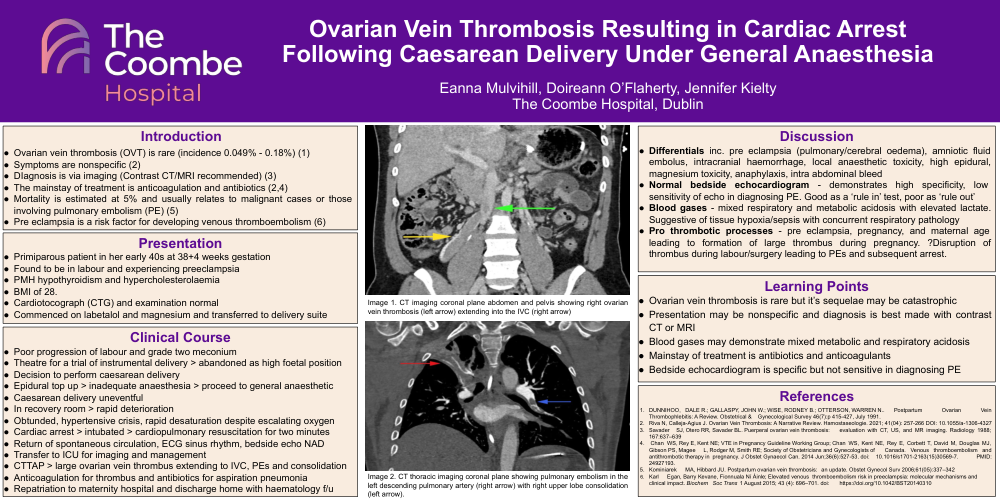
CTTAP > large ovarian vein thrombus extending to IVC, PEs and consolidation
Anticoagulation for thrombus and antibiotics for aspiration pneumonia
Repatriation to maternity hospital and discharge home with haematology f/u
Discussion
Differentials inc. pre eclampsia (pulmonary/cerebral oedema), amniotic fluid embolus, intracranial haemorrhage, local anaesthetic toxicity, high epidural, magnesium toxicity, anaphylaxis, intra abdominal bleed
Normal bedside echocardiogram - demonstrates high specificity, low sensitivity of echo in diagnosing PE. Good as a ‘rule in’ test, poor as ‘rule out’
Blood gases - mixed respiratory and metabolic acidosis with elevated lactate. Suggestive of tissue hypoxia/sepsis with concurrent respiratory pathology
Pro thrombotic processes - pre eclampsia, pregnancy, and maternal age leading to formation of large thrombus during pregnancy. ?Disruption of thrombus during labour/surgery leading to PEs and subsequent arrest.
Learning Points
Ovarian vein thrombosis is rare but it’s sequelae may be catastrophic
Presentation may be nonspecific and diagnosis is best made with contrast CT or MRI
Blood gases may demonstrate mixed metabolic and respiratory acidosis
Mainstay of treatment is antibiotics and anticoagulants
Bedside echocardiogram is specific but not sensitive in diagnosing PE