215 posters, 5 topics, 22 sessions, 596 authors, 283 institutions
ePostersLive by SciGen Technologies S.A. All rights reserved.
Obstetric Anaesthesia Annual Scientific Meeting 2025
May 15 - 16, 2025 | ICC, 2 Lanyon Place, Belfast BT1 3WH

6779422
A case report of a parturient with supraventricular tachycardia intrapartum.
Poster Presenter
Part of Topic
Case report
Case
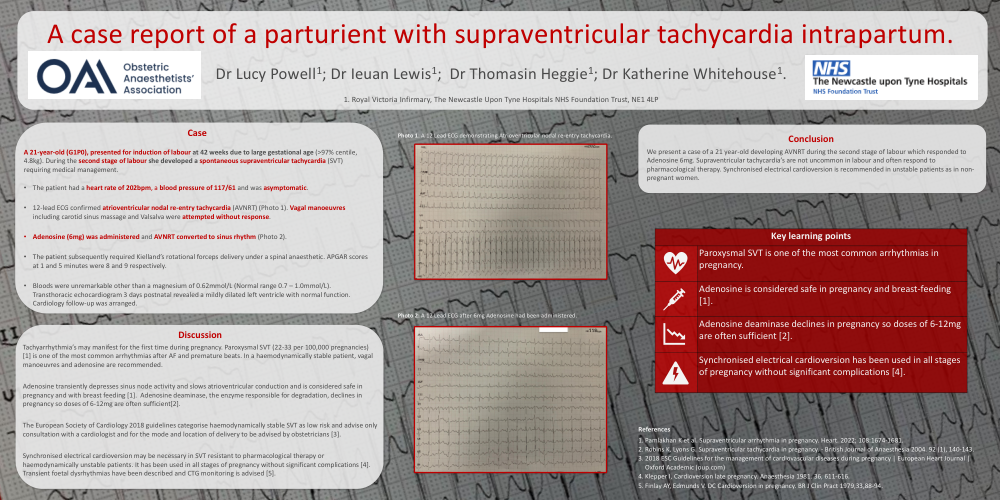
A 21-year-old (G1P0), presented for induction of labour at 42 weeks due to large gestational age (>97% centile, 4.8kg). During the second stage of labour she developed a spontaneous supraventricular tachycardia (SVT) requiring medical management.
Discussion
Tachyarrhythmia’s may manifest for the first time during pregnancy. Paroxysmal SVT (22-33 per 100,000 pregnancies) [1] is one of the most common arrhythmias after AF and premature beats. In a haemodynamically stable patient, vagal manoeuvres and adenosine are recommended.
Adenosine transiently depresses sinus node activity and slows atrioventricular conduction and is considered safe in pregnancy and with breast feeding [1]. Adenosine deaminase, the enzyme responsible for degradation, declines in pregnancy so doses of 6-12mg are often sufficient[2].
The European Society of Cardiology 2018 guidelines categorise haemodynamically stable SVT as low risk and advise only consultation with a cardiologist and for the mode and location of delivery to be advised by obstetricians [3].
Synchronised electrical cardioversion may be necessary in SVT resistant to pharmacological therapy or haemodynamically unstable patients. It has been used in all stages of pregnancy without significant complications [4]. Transient foetal dysrhythmias have been described and CTG monitoring is advised [5].
Conclusion
We present a case of a 21 year-old developing AVNRT during the second stage of labour which responded to Adenosine 6mg. Supraventricular tachycardia’s are not uncommon in labour and often respond to pharmacological therapy. Synchronised electrical cardioversion is recommended in unstable patients as in non-pregnant women.
References