215 posters, 5 topics, 22 sessions, 596 authors, 283 institutions
ePostersLive by SciGen Technologies S.A. All rights reserved.
Obstetric Anaesthesia Annual Scientific Meeting 2025
May 15 - 16, 2025 | ICC, 2 Lanyon Place, Belfast BT1 3WH

6779413
The eventful labour of a scientologist with hyponatraemic seizures and a major obstetric haemorrhage
Poster Presenter
Part of Topic
Case report
The eventful labour of a scientologist with hyponatraemic seizures and a major obstetric haemorrhage
Introduction
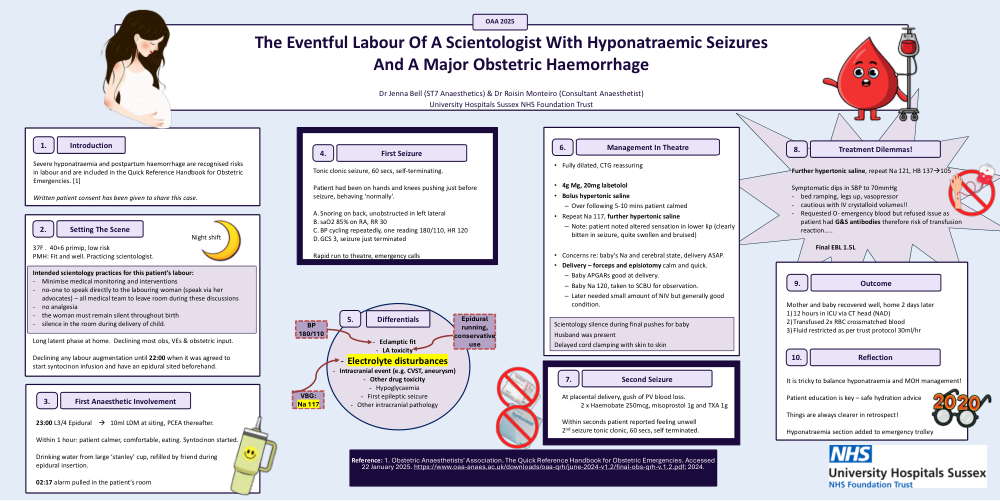
Severe hyponatraemia and postpartum haemorrhage are recognised risks in labour and are included in the Quick Reference Handbook for Obstetric Emergencies. [1] Written patient consent has been given to share this case.
Case report
A 37 year old low-risk primiparous patient was admitted after a long latent phase at home. She was a practicing scientologist with the following labour plan: no-one to speak directly to her (communication should be via two birth partners), she must remain silent during labour and the room must be silent during the second stage of labour. She declined much of the midwifery and obstetric advice, including observations, examinations and fluid balance monitoring. She drank large volumes of water during labour and spent longer than advised in the birthing pool. Her labour did not progress as hoped and an epidural was sited and syntocinon started to augment the second stage of labour. A few hours later, at two AM, the patient had a tonic clonic seizure while pushing. The patient’s serum sodium was promptly identified as 117mmol/L and the syntocinon infusion was stopped. Immediately following the seizure, the patient was combative and persistently hypertensive. Intravenous sodium chloride and magnesium were given, the patient was transferred to theatre and an arterial line was sited which showed lower systolic BPs at ~160mmHg. The CTG was reassuring and the patient responded rapidly to treatment. The delivery of the baby was assisted by forceps uneventfully, her partner was present in theatre and the patient’s wishes for silence were respected. With the delivery of the placenta the patient had a brisk haemorrhage of 1500ml with some haemodynamic compromise and a second seizure. The simultaneous treatment of the seizure and haemorrhage presented a dilemma compounded by the patient not being able to receive O- blood due to antibodies in her screen. The patient received carboprost, misoprostol, slow tranexamic acid, vasopressors and sodium chloride and responded well to treatment.
Discussion
This case was challenging both due to clinical complexity and human factors. Fortunately, the clinical team had discussed a plan regarding uterotonics in view of the low sodium and hypertension, aiding rapid decision making. Following this case, the patient information regarding safe hydration was updated, obstetric hyponatraemia trust guidelines were updated, and a hyponatraemia box is going to be added to the emergency trolley.
Reference
1. Obstetric Anaesthetists’ Association. The Quick Reference Handbook for Obstetric Emergencies. Accessed 22 January 2025. https://www.oaa-anaes.ac.uk/downloads/oaa-qrh/june-2024-v1.2/final-obs-qrh-v.1.2.pdf; 2024.