191 posters, 5 topics, 20 sessions, 393 authors, 116 institutions
ePostersLive by SciGen Technologies S.A. All rights reserved.
Obstetric Anaesthesia Annual Scientific Meeting 2023
18 - 19 May, 2023 | EICC Edinburgh

5809972
Measuring the distance to the epidural space in women of childbearing age: preliminary results from a retrospective MRI study
Poster Presenter
Part of Topic
Original Research
Introduction
- Epidural depth is difficult to predict, especially for patients with raised BMI.
- Raised BMI increases distance from skin to the spinous processes, butshould not affect distance between supraspinous ligament and the posterior epidural space.
- Our study sought to ascertain if this distance was consistent amongst women of childbearing age, and whether it was associated with height, weight or BMI.
- Comparison was performed of distance from supraspinous ligament to the epidural space in patients of different ethnicities, in light of MBRRACE-UKreports repeatedly showing ethnicity to be associated with poorer maternal and neonatal outcomes.
Methods
- Retrospective review of all MRI spine studies performed in women of childbearing age (18-45) in our hospital in 2016.
- Distance from supraspinous ligament to the posterior epidural space was measured at each lumbar interspace (L1-L2 to L5-S1). All measurements were performed twice, by independent data collectors.
- Scans were excluded if there were either congenital or acquired diseases of the bony spine, or if MRI measurements from different data collectors were >10% apart.
- Mean distance from supraspinous ligament to the epidural space was calculated.
- Electronic records were examined to determine ethnicity, height, weight and BMI.
- Statistical analysis was by linear regression with calculation of correlation coefficients for height, weight and BMI vs distance to the epidural space, and use of the Mann-Whitney U Test to analyse the effect of ethnicity.
Results
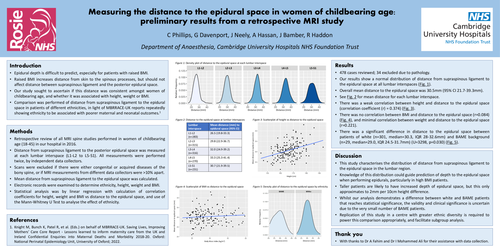
- 478 cases reviewed; 34 excluded due to pathology.
- Our results show a normal distribution of distance from supraspinous ligament to the epidural space at all lumbar interspaces (Fig. 1).
- Overall mean distance to the epidural space was 30.5mm (95% CI 21.7-39.3mm).
- See Fig. 2 for mean distance for each lumbar interspace.
- There was a weak correlation between height and distance to the epidural space (correlation coefficient (r) = 0.374) (Fig. 3).
- There was no correlation between BMI and distance to the epidural space (r=0.084) (Fig. 4), and minimal correlation between weight and distance to the epidural space (r=0.221).
- There was a significant difference in distance to the epidural space between patients of white (n=301, median=30.3, IQR 28-32.6mm) and BAME background (n=29,median=29.0, IQR 24.5-31.7mm) (U=3298, p=0.030) (Fig. 5).
Discussion
- This study characterises the distribution of distance from supraspinous ligament to the epidural space in the lumbar region.
- Knowledge of this distribution could guide prediction of depth to the epidural space when performing epidurals, particularly in high BMI patients.
- Taller patients are likely to have increased depth of epidural space, but this only approximates to 2mm per 10cm height difference.
- Whilst our analysis demonstrates a difference between white and BAME patients that reaches statistical significance, the validity and clinical significance is uncertain due to the very small number of BAME patients.
- Replication of this study in a centre with greater ethnic diversity is required to power this comparison appropriately, and facilitate subgroup analysis.
References
1. Knight M, Bunch K, Patel R, et al. (Eds.) on behalf of MBRRACE-UK. Saving Lives, Improving Mothers’ Care Core Report - Lessons learned to inform maternity care from the UK and Ireland Confidential Enquiries into Maternal Deaths and Morbidity 2018-20. Oxford: National Perinatal Epidemiology Unit, University of Oxford; 2022.