191 posters, 5 topics, 20 sessions, 393 authors, 116 institutions
ePostersLive by SciGen Technologies S.A. All rights reserved.
Obstetric Anaesthesia Annual Scientific Meeting 2023
18 - 19 May, 2023 | EICC Edinburgh

5763331
Factors associated with general anaesthesia in elective caesarean section
Poster Presenter
Authors
Annie Evans, Rona Myatt, Andrew McCallum, Malcolm A Broom, Martin Shaw, Rachel J Kearns
Affiliations
Foundation Doctor, West of Scotland, Foundation Doctor, North of Scotland, Specialty Registrar, West of Scotland School of Anaesthesia, Consultant Anaesthetist, Princess Royal Maternity Unit, Glasgow, Department of Medical Physics, Glasgow Royal Infirmary
Part of Topic
Original Research
Compared with neuraxial anaesthesia, general anaesthesia (GA) for caesarean section is associated with increased maternal and neonatal morbidity.1,2 GA may be required when neuraxial anaesthesia is contraindicated, where delivery must be expedited, or at maternal request. Reducing avoidable GA for caesarean delivery may improve safety for obstetric patients, but little is known on why patients undergo elective GA.3 This study aims to characterise the factors associated with the use of GA in elective caesarean section.
Retrospective study of all patients receiving GA for elective caesarean section from 1/1/2017 – 31/12/2020 in a tertiary unit with ~5500 deliveries per year. We compared patients receiving GA (n=50) with a control group receiving spinal anaesthesia (n=100). Data were obtained from electronic health records and were anonymised prior to analysis. GA and caesarean section were defined as being at “maternal request” if there was no documented medical indication, and if it was clearly described that the patient had requested the procedure. Univariate and multivariable logistic regression analysis were performed to identify factors associated with GA. R version 3.6.2 (R Foundation for Statistical Computing) was used for all analyses. Caldicott Guardian approval was obtained and ethical approval was deemed unnecessary by the West of Scotland Ethics Service.
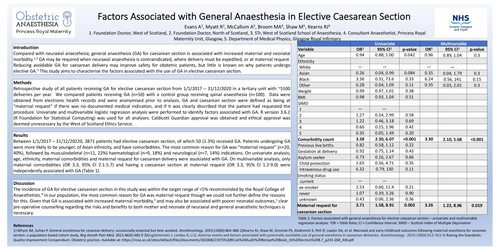
Between 1/1/2017 – 31/12/20220, 3871 patients had elective caesarean section, of which 50 (1.3%) received GA. Patients undergoing GA were more likely to be younger, of Asian ethnicity, and have comorbidities. The most common reason for GA was “maternal request” (n=20, 40%), followed by musculoskeletal (n=11, 22%) haematological (n=9, 18%) and neurological (n=7, 14%) indications. On univariate analysis; age, ethnicity, maternal comorbidities and maternal request for caesarean delivery were associated with GA. On multivariable analysis, only maternal comorbidities (OR 3.3, 95% CI 2.1-5.7) and having a caesarean section at maternal request (OR 3.3, 95% CI 1.2-9.0) were independently associated with GA (Table 1).
The incidence of GA for elective caesarean section in this study was within the target range of <5% recommended by the Royal College of Anaesthetists.4 In our population, the most common reason for GA was maternal request though we could not further define the reasons for this. Given that GA is associated with increased maternal morbidity,3and may also be associated with poorer neonatal outcomes,1 clear pre-operative counselling regarding the risks and benefits to both mother and neonate of neuraxial and general anaesthetic techniques is necessary.