191 posters, 5 topics, 20 sessions, 393 authors, 116 institutions
ePostersLive by SciGen Technologies S.A. All rights reserved.
Obstetric Anaesthesia Annual Scientific Meeting 2023
18 - 19 May, 2023 | EICC Edinburgh

5765702
The role of TEG6s in managing major obstetric haemorrhage
Poster Presenter
Authors
Part of Topic
Original Research
Background and aims:
Coagulopathy is one cause of major obstetric haemorrhage (MOH), and MOH is a leading cause of maternal morbidity and mortality, worldwide [1]. TEG6s (a type of viscoelastic haemostatic assay), provides point-of-care coagulation testing, with rapid results, making it potentially more useful in MOH than traditional laboratory tests [2].
This project had three parts, with distinct aims. The aim in part one was to establish a TEG6s local reference range for parturients. In part two, we aimed to describe how TEG6s measurement of Functional Fibrinogen correlates with laboratory Clauss Fibrinogen in parturients, and to determine how reliably it can detect a Clauss Fibrinogen <2g/L. In part three, we aimed to establish, based on early data, whether TEG6s has influenced the patterns of blood product usage in MOH.
Methods:
Data was collected from healthy (non-MOH) parturients and MOH patients, including: TEG6s and laboratory coagulation results, baseline demographic information (age, gestation, BMI, weight) and blood loss.
Reference ranges with 95% confidence intervals were calculated using data from healthy 2nd/3rd trimester parturients.
Pearson correlation was used to explore the relationship between Clauss Fibrinogen and Functional Fibrinogen, using healthy and MOH patients. The threshold for Functional Fibrinogen detecting a Clauss Fibrinogen <2g/L was determined using a generalised linear mixed effects model, to maximise use of a small data set and allow incorporation of repeated measurements taken from MOH patients.
Blood products were compared by propensity score matching the MOH patients to a cohort of MOH patients from before the introduction of TEG6s and creating a mixed effects model.
Results:
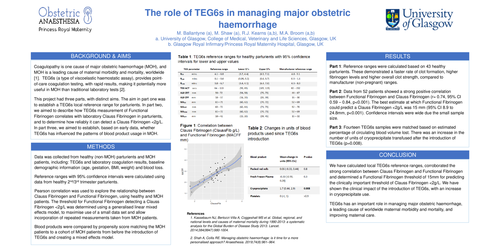
Part 1: Reference ranges were calculated based on 43 healthy parturients. These demonstrated a faster rate of clot formation, higher fibrinogen levels and higher overall clot strength, compared to manufacturer (non-pregnant) ranges.
Part 2: Data from 52 patients showed a strong positive correlation between Functional Fibrinogen and Clauss Fibrinogen (r= 0.74, 95% CI 0.59 – 0.84, p<0.001). The best estimate at which Functional Fibrinogen could predict a Clauss Fibrinogen <2g/L was 15 mm (95% CI 8.9 to 24.8mm, p<0.001). Confidence intervals were wide due the small sample size.
Part 3: Fourteen TEG6s samples were matched based on estimated percentage of circulating blood volume lost. There was an increase in the number of units of cryoprecipitate transfused after the introduction of TEG6s (p=0.008).
Conclusion:
We have calculated local TEG6s reference ranges, corroborated the strong correlation between Clauss Fibrinogen and Functional Fibrinogen and determined a Functional Fibrinogen threshold of 15mm for predicting the clinically important threshold of Clauss Fibrinogen <2g/L. We have shown the clinical impact of the introduction of TEG6s, with an increase in cryoprecipitate use.
TEG6s has an important role in managing major obstetric haemorrhage, a leading cause of worldwide maternal morbidity and mortality, and improving maternal care.