191 posters, 5 topics, 20 sessions, 393 authors, 116 institutions
ePostersLive by SciGen Technologies S.A. All rights reserved.
Obstetric Anaesthesia Annual Scientific Meeting 2023
18 - 19 May, 2023 | EICC Edinburgh

5765650
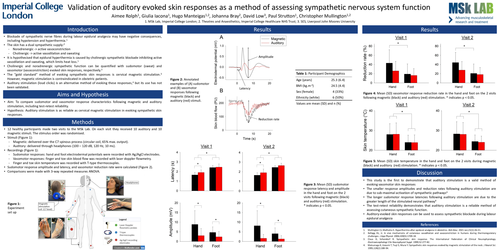
Validation of auditory evoked skin responses as a method of assessing sympathetic nervous system function
Poster Presenter
Part of Topic
Original Research
Validation of auditory evoked skin responses as a method of assessing sympathetic nervous system function
Introduction
•Blockade of sympathetic nerve fibres during labour epidural analgesia may have negative consequences, including hypotension and hyperthermia.1
•The skin has a dual sympathetic supply:2
-Noradrenergic -> active vasoconstriction
-Cholinergic -> active vasodilation and sweating
•It is hypothesised that epidural hyperthermia is caused by cholinergic sympathetic blockade inhibiting active vasodilation and sweating, which limits heat loss.1
•Cholinergic and noradrenergic sympathetic function can be quantified with sudomotor (sweat) and vasomotor (vasoconstriction) evoked skin responses, respectively.3
•The “gold standard” method of evoking sympathetic skin responses is cervical magnetic stimulation.3 However, magnetic stimulation is contraindicated in obstetric patients.
•Auditory stimulation (loud clicks) is an alternative method of evoking these responses,4 but its use has not been validated.
Aims and Hypothesis
•Aim: To compare sudomotor and vasomotor response characteristics following magnetic and auditory stimulation, including test-retest reliability.
•Hypothesis: Auditory stimulation is as reliable as cervical magnetic stimulation in evoking sympathetic skin responses.
Methods
•12 healthy participants made two visits to the MSk Lab. On each visit they received 10 auditory and 10 magnetic stimuli. The stimulus order was randomised.
•Stimuli (Figure 1):
-Magnetic: delivered over the C7 spinous process (circular coil, 65% max. output).
-Auditory: delivered through headphones (100 – 120 dB, 120 Hz, 10 ms).
•Recordings (Figure 1):
-Sudomotor responses: hand and foot electrodermal potentials were recorded with Ag/AgCl electrodes.
-Vasomotor responses: finger and toe skin blood flow was recorded with laser doppler flowmetry.
-Finger and toe skin temperature was recorded with T-type thermocouples.
•Sudomotor response amplitude and latency, and vasomotor reduction rate were calculated (Figure 2).
•Comparisons were made with 3-way repeated measures ANOVA.
Discussion
•This study is the first to demonstrate that auditory stimulation is a valid method of evoking vasomotor skin responses
•The smaller response amplitudes and reduction rates following auditory stimulation are due to sub-maximal activation of sympathetic pathways4
•The longer sudomotor response latencies following auditory stimulation are due to the greater length of the stimulated neural pathway4
•The test-retest reliability demonstrates that auditory stimulation is a reliable method of assessing cutaneous sympathetic function.
•Auditory-evoked skin responses can be used to assess sympathetic blockade during labour epidural analgesia