191 posters, 5 topics, 20 sessions, 393 authors, 116 institutions
ePostersLive by SciGen Technologies S.A. All rights reserved.
Obstetric Anaesthesia Annual Scientific Meeting 2023
18 - 19 May, 2023 | EICC Edinburgh

5809967
Impact of focusing definitions of postpartum haemorrhage
Poster Presenter
Authors
Part of Topic
Service Evaluation
Impact of focussing definitions of postpartum haemorrhage
M Davidson, R Junkin, A Clark
Department of Anaesthesia, University Hospital Crosshouse
Introduction
Major obstetric haemorrhage (MOH) after C-section has varied definitions but is generally thought to be a blood loss in excess of 1500ml and this threshold may be used to trigger a MOH protocol [1]. This is considered to represent a 30% blood loss, or class 3 shock, in the typical 70kg adult with 70ml/Kg blood volume. However normal maternal physiology produces an increase in blood volume approaching 100ml/Kg in late gestation. Additionally, the spectrum of patient BMI, from decreased to increased, introduces considerable over and underestimation of respective haemorrhage significance when thought of as a simple discrete volume. When a 50Kg patient bleeds 1500mls it is of higher impact proportionally than a 100Kg patient exposed to the same blood loss, yet both are described as having a major PPH by traditional blood loss volume definitions. It is important to have more bespoke definitions to estimate the impact of blood loss to better guide appropriate resuscitation and decide on correct placement in HDU postoperatively. We aim to examine the impact of defining a patient group’s intraoperative bleeding by three different means – actual blood loss, percentage blood loss for actual body weight (ABW) and percentage blood loss for ideal body weight (IBW).
Methods
A retrospective audit of patients undergoing either elective or emergency caesarean section between January 2021 and May 2021 in a district general hospital was carried out. We examined the data for patient height, weight and actual blood loss. For each patient we calculated percentage blood volume losses assuming 100ml/Kg total blood volume for both ABW and IBW (using the Devine formula). Additionally we subjected this data to locally established definitions of MOH at both 1500ml and 30% blood volume loss.
Results
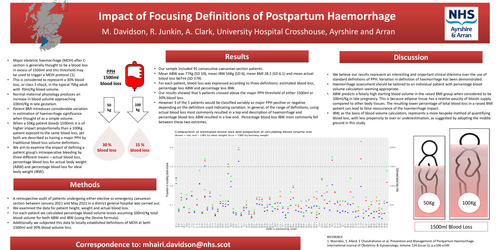
Our sample included 91 consecutive caesarean section patients. Mean ABW was 77Kg (SD 19), mean IBW 56Kg (SD 6), mean BMI 28.5 (SD 6.1) and mean actual blood loss 667ml (SD 379). The results are shown in Figure.1, ordered consecutively by increasing BMI. For each patient blood loss is expressed according to three definitions: estimated blood loss, percentage loss ABW and percentage loss IBW, with a major PPH definition described by the horizontal threshold.
Our results showed that 5 patients crossed above the major PPH threshold of either 1500ml or 30% blood loss. However 3 of the 5 patients would be classified variably as major PPH positive or negative depending on the definition used indicating variation. In general, of the range of definitions, using actual blood loss most commonly resulted in a top end description of haemorrhage and percentage blood loss ABW resulted in a low end. Percentage blood loss IBW most commonly fell between these two extremes.
Discussion
We believe our results represent an interesting and important clinical dilemma over the use of standard definitions of PPH. Variation in definition of haemorrhage has been demonstrated. Haemorrhage assessment should be tailored to an individual patient with percentage blood volume calculation seeming appropriate. However, even this is further modified as obese patients represent a subgroup with an increased proportion of body adipose tissue. With adipose tissue described as having a relative paucity of perfusing blood compared to other body tissues the use of 100ml/Kg ABW predicts a falsely high starting blood volume in this raised BMI group. The resulting percentage blood loss in a raised BMI patient leads to false reassurance of the haemorrhage impact. In conclusion IBW as the basis of blood volume calculation represents a more bespoke method of quantifying blood loss, with less propensity to over or underestimation, as suggested by adopting the middle ground in this study.
References
E. Mavrides, S. Allard, E Chandraharan et al. Prevention and Management of Postpartum Haemorrhage. International Journal of Obstetrics & Gynaecology, Volume 124; Issue 5: p. e106-e149