191 posters, 5 topics, 20 sessions, 393 authors, 116 institutions
ePostersLive by SciGen Technologies S.A. All rights reserved.
Obstetric Anaesthesia Annual Scientific Meeting 2023
18 - 19 May, 2023 | EICC Edinburgh

5766105
Total intravenous anaesthesia for caesarean delivery - incidence and outcomes from a tertiary centre
Poster Presenter
Authors
Part of Topic
Service Evaluation
Introduction
•Caesarean delivery (CD) under general anaesthesia (GA) is traditionally performed using an intravenous induction agent followed by maintenance of anaesthesia with a volatile agent.
•Total intravenous anaesthesia (TIVA) is becoming increasingly utilised in non-obstetric settings as the anaesthetic technique of choice due to conferring benefits such as better patient recovery and reduced environmental impact on global warming.
Method
•After obtaining audit committee approval, we reviewed electronic records of all patients having a caesarean delivery (CD) under GA at St. Mary’s Hospital, Manchester between January 1st 2021 and August 31st 2022.
•
•Our objective was to analyse caesarean deliveries performed using TIVA technique.
•Our aim was to highlight the patient characteristics, TIVA techniques utilised for GA along with the associated maternal and neonatal outcomes.
Results
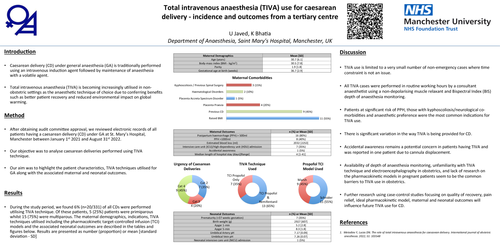
•During the study period, we found 6% (n=20/331) of all CDs were performed utilising TIVA technique. Of these patients, 5 (25%) patients were primiparous whilst 15 (75%) were multiparous. The maternal demographics, indications, TIVA techniques utilised including the pharmacokinetic target-controlled infusion (TCI) models and the associated neonatal outcomes are described in the tables and figures below. Results are presented as number (proportion) or mean [standard deviation - SD]
Discussion
•TIVA use is limited to a very small number of non-emergency cases where time constraint is not an issue.
•All TIVA cases were performed in routine working hours by a consultant anaesthetist using a non-depolarising muscle relaxant and Bispectral Index (BIS) depth of anaesthesia monitoring.
•
•Patients at significant risk of PPH, those with kyphoscoliosis/neurological co-morbidities and anaesthetic preference were the most common indications for TIVA use.
•There is significant variation in the way TIVA is being provided for CD.
•Accidental awareness remains a potential concern in patients having TIVA and was reported in one patient due to cannula displacement.
•Availability of depth of anaesthesia monitoring, unfamiliarity with TIVA technique and electroencephalography in obstetrics, and lack of research on the pharmacokinetic models in pregnant patients seem to be the common barriers to TIVA use in obstetrics.
•Further research using case-control studies focusing on quality of recovery, pain relief, ideal pharmacokinetic model, maternal and neonatal outcomes will influence future TIVA use for CD.
•
References
1.Metodiev Y, Lucas DN. The role of total intravenous anaesthesia for caesarean delivery. International journal of obstetric anesthesia. 2022; 51: 103548