191 posters, 5 topics, 20 sessions, 393 authors, 116 institutions
ePostersLive by SciGen Technologies S.A. All rights reserved.
Obstetric Anaesthesia Annual Scientific Meeting 2023
18 - 19 May, 2023 | EICC Edinburgh

5768618
Retrospective review of women who received fibrinogen concentrate during treatment of postpartum haemorrhage at the Rotunda Hospital from 2019-2021
Poster Presenter
Authors
Part of Topic
Service Evaluation
Title:
Retrospective review ofwomen who receivedfibrinogen concentrateduring treatment of PPHin the Rotunda Hospital from 2019-2021
Introduction:
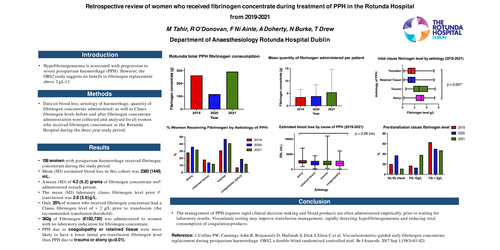
•Hypofibrinogenaemia is associated with progression to severepostpartum haemorrhage (PPH). However, the OBS2 study suggestsno benefit to fibrinogenreplacement above 2 g.L-1.1
Methods:
•Data on blood loss, aetiology ofhaemorrhage, quantity of fibrinogen concentrate administered, as well as Clauss fibrinogen levels before and after fibrinogen concentrate administration were collected andanalysed for all women whoreceived fibrinogen concentrate at the Rotunda Hospital during thethree-year study period.
Results:
•159 women with postpartum haemorrhage received fibrinoge concentrate during the studyperiod.
•Mean (SD) estimated blood loss in this cohort was 2383 (1445 mL.
•A mean (SD) of 4.2 (6.2) grams of fibrinogen concentrate wer administered to each patient.
•The mean (SD) laboratory clauss fibrinogen level prior t transfusion was 2.8 (5.6) g/L.
•Only 25% of women who receivedfibrinogen concentrate had a Clauss fibrinogen level of < 2 g/L prior to transfusion (the recommendedtransfusion threshold).
•362g of Fibrinogen (€192,730) was administered to women with nolaboratory indication for fibrinogenconcentrate.
•PPH due to coagulopathy or retained tissue were more likelyto have a lower initial pre-transfusion fibrinogen level thanPPH due to trauma or atony(p<0.01).
Conclusion:
•The management of PPH requiresrapid clinical decision making andblood products are oftenadministered empirically, prior towaiting for laboratory results. Viscoelastic testing may improve transfusion management, rapidly detecting hypofibrinogenaemia and reducing total consumption of coagulation products.