191 posters, 5 topics, 20 sessions, 393 authors, 116 institutions
ePostersLive by SciGen Technologies S.A. All rights reserved.
Obstetric Anaesthesia Annual Scientific Meeting 2023
18 - 19 May, 2023 | EICC Edinburgh

5752909
Neuraxial blockade during caesarean section; failure and intraoperative pain
Poster Presenter
Authors
Affiliations
Part of Topic
Service Evaluation
NEURAXIAL BLOCKADE DURING CAESAREAN SECTION; FAILURE AND INTRAOPERATIVE PAIN
Jasprit Sidhu, Camilla Gordon, Danny Wong, Neel Desai
Introduction
Neuraxial blockade is the most common mode of anaesthesia for caesarean section (CS), and currently the complaint of pain rather than accidental awareness under general anaesthesia is now the most common successful medicolegal claim in obstetric anaesthesia [1]. Clinical practice, however, is subject to considerable variation with continued debate, and many aspects of obstetric practice remain unresolved, all having the potential to affect the experience of the patient’s caesarean delivery and the occurrence of neuraxial failure and/or intraoperative pain [2, 3]. Guidance on the prevention and management of intraoperative pain has only recently been published [4].
A systematic review reported the incidence of inadequate neuraxial anaesthesia in CS as 10.2% for combined spinal-epidurals (CSE) and spinals and 30.3% for epidural top ups [5], which we felt was rather high. Interpretation of these data was limited by the de novo placement of epidurals rather than those established for labour analgesia, a practice not often used in modern obstetric practice and any supplementation of epidural drugs deemed the epidural as a failed block. A further prospective 5 year audit found that the incidence of intraoperative pain for CSE and spinal compared to epidural top up was 4.6% and 14.1% respectively [6]. In this study the volume of heavy marcain was limited to 2.5ml.
We sought to determine the rate of neuraxial failure and intraoperative pain and its management in our tertiary maternity unit.
Methods
Approval for this service evaluation was gained from the governance team. Data was collected prospectively using a paper based questionnaire completed by anaesthetists of any grade. All women having CS under primary neuraxial anaesthesia over a 4 week period in October were included. Any woman having a primary general anaesthetic was excluded.
Our aims were to find:
Results
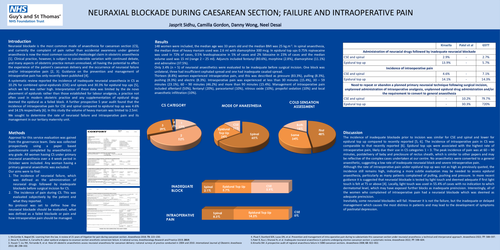
148 women were included, the median age was 33 years old and the median BMI was 25 kg.m-1. In spinal anaesthesia, the median dose of heavy marcain used was 2.6 ml with diamorphine 300 mcg. In epidural top ups 0.75% ropivacaine was used in 72% of cases, 0.5% levobupivacaine in 5% of cases and 2% lidocaine in 23% of cases and the median volume used was 15 ml (range 2 – 25 ml). Adjuncts included fentanyl (80.6%), morphine (2.8%), diamorphine (11.1%) and adrenaline (37.5%).
Only 3.4% (n = 5) of neuraxial anaesthetics were evaluated to be inadequate before surgical incision. One block was unilateral, three had insufficient cephalad spread and one had inadequate caudad spread.
Thirteen (8.8%) women experienced intraoperative pain, and this was described as pressure (83.3%), pulling (8.3%), pushing (8.3%) and electric (8.3%). Intraoperative pain was experienced at less than 30 minutes (15.4%), 30 – 59 minutes (23.1%), 60 – 90 minutes (46.2%) and more than 90 minutes (15.4%). Management of intraoperative pain included alfentanil (50%), fentanyl (20%), paracetamol (10%), nitrous oxide (10%), propofol sedation (10%) and local anaesthetic infiltration (10%).
Discussion
The incidence of inadequate blockade prior to incision was similar for CSE and spinal and lower for epidural top up compared to recently reported [5, 6]. The incidence of intraoperative pain in CS was comparable to that recently reported [6]. Epidural top ups were associated with the highest rate of intraoperative pain, likely due their use in CS categories 1 – 3. The peak incidence of pain was at 60 – 90 minutes, postdelivery of baby and preclosure of rectus sheath, which is similar to other papers and may be reflective of the complex cases undertaken at our centre. No anaesthetics were converted to a general anaesthetic, suggesting a low rate of inadequate neuraxial block and severe intraoperative pain.
Although the rate of intraoperative pain under epidural top up was not as high as previously quoted, the incidence still remains high, indicating a more subtle evaluation may be needed to assess epidural anaesthesia, particularly as many patients complained of pulling, pushing and pressure. In more recent guidance it is suggested that neuraxial blockade is tested by light touch and deemed adequate if first light touch is felt at T5 or above [4]. Locally, light touch was used in 55.4% of cases with no indication to which dermatomal level, which may have exposed further blocks as inadequate preincision. Interestingly, all of the women who complained of intraoperative pain had a neuraxial blockade which was deemed as adequate preincision.
Inevitably, some neuraxial blockades will fail. However it is not the failure, but the inadequate or delayed management which causes the most distress in patients and may lead to the development of symptoms of postnatal depression.