191 posters, 5 topics, 20 sessions, 393 authors, 116 institutions
ePostersLive by SciGen Technologies S.A. All rights reserved.
Obstetric Anaesthesia Annual Scientific Meeting 2023
18 - 19 May, 2023 | EICC Edinburgh

5809768
Socioeconomic disparity in anaesthesia for caesarean section
Poster Presenter
Authors
Part of Topic
Original Research
Introduction: National reports have highlighted increased maternal morbidity and mortality associated with socioeconomic deprivation [1]. General anaesthesia for caesarean section is associated with increased risk of maternal morbidity compared with regional anaesthesia. We explore the relationship between socioeconomic status and use of general anaesthesia for caesarean section.
Methods: Population-based study of National Health Service data for all births delivered by caesarean section (24+0-43+6 weeks gestation) in Scotland between 1st January 2007 and 31st October 2020. Socioeconomic status was defined using Scottish Index of Multiple Deprivation (SIMD), with SIMD1 the most, and SIMD10 the least deprived residential areas. Results were presented as both relative and absolute risks with 95% confidence intervals. The Public Benefit and Privacy Panel for Health and Social Care (HSC-PBPP) of NHS Scotland provided necessary approvals for the linkage.
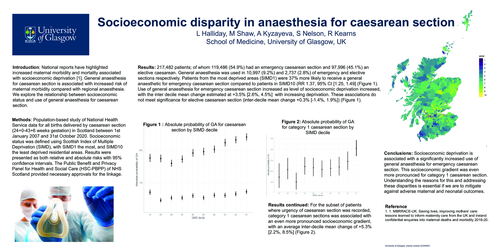
Results: 217,482 patients; of whom 119,486 (54.9%) had an emergency caesarean section and 97,996 (45.1%) an elective caesarean. General anaesthesia was used in 10,997 (9.2%) and 2,737 (2.8%) of emergency and elective sections respectively. Patients from the most deprived areas (SIMD1) were 37% more likely to receive a general anaesthetic for emergency caesarean section compared to patients in SIMD10 (RR 1.37, 95% CI [1.25, 1.49] (Figure 1). Use of general anaesthesia for emergency caesarean section increased as level of socioeconomic deprivation increased, with the inter decile mean change estimated at +3.5% [2.6%, 4.5%] with increasing deprivation. These associations do not meet significance for elective caesarean section (inter-decile mean change +0.3% [-1.4%, 1.9%]) (Figure 1).
Results continued: For the subset of patients where urgency of caesarean section was recorded, category 1 caesarean sections was associated with an even more pronounced socioeconomic gradient, with an average inter-decile mean change of +5.3% [2.2%, 8.5%] (Figure 2).
Conclusions: Socioeconomic deprivation is associated with a significantly increased use of general anaesthesia for emergency caesarean section. This socioeconomic gradient was even more pronounced for category 1 caesarean section. Understanding the reasons for this and addressing these disparities is essential if we are to mitigate against adverse maternal and neonatal outcomes.
Reference
1. 1. MBRRACE-UK. Saving lives, improving mothers’ care: lessons learned to inform maternity care from the UK and Ireland confidential enquiries into maternal deaths and morbidity 2018-20.