191 posters, 5 topics, 20 sessions, 393 authors, 116 institutions
ePostersLive by SciGen Technologies S.A. All rights reserved.
Obstetric Anaesthesia Annual Scientific Meeting 2023
18 - 19 May, 2023 | EICC Edinburgh

5809760
Maternal request caesarean delivery: understanding the impact on elective section list efficiency. What can we learn?
Poster Presenter
Authors
Affiliations
Part of Topic
Service Evaluation
Maternal Request Caesarean Delivery:
Understanding the impact on elective section list efficiency.
Dr Ross McLaren and Dr Sally Shiels, Oxford University Hospitals NHS Foundation Trust
Introduction:
-
The rate of birth by caesarean section (CS) is increasing.
-
NICE guidelines state that maternal request caesarean sections
(MRCS) should be performed.
-
The Ockenden Review recommended ending the use of CS rates
as a measure of maternity services.
-
Currently, our elective CS (ElCS) list at Oxford University Hospitals NHS Foundation Trust accommodates up to 5 patients per day and MRCS was introduced locally in 2021.
-
To manage the increase in MRCS, it will be necessary to improve the list efficiency or expand the operating time.
-
We undertook a service evaluation of ElCS lists to assess their efficiency, identify causes of delays, and review the impact of MRCS.
There were no specific standards against which the service could be audited, so a service evaluation was performed. The project was approved by the trust’s audit department. A proforma was designed with MDT input for completion by the anaesthetist during each list.
The data collected included: staffing for the list; the indications for CS; and the timings of different aspects of the patient’s peri-operative care. Free text comments regarding list efficiency were encouraged. Data were collected from 17/11/2022 to 09/01/2023.
The data were entered into and analysed in Microsoft Excel. Surgeries and dedicated lists for abnormally invasive placentas were excluded.
Results:
List Overview
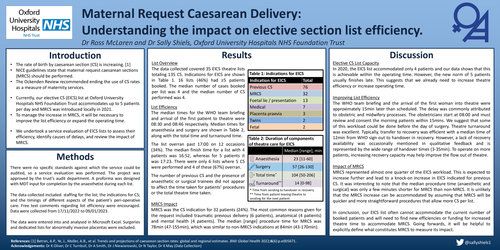
The data collected covered 35 ElCS theatre lists totaling 135 CS. Indications for ElCS are shown in Table 1. 16 lists (46%) had ≥5 patients booked. The median number of cases booked per list was 4 and the median number of CS performed was 4.
List Efficiency
The median times for the WHO team briefing and arrival of the first patient to theatre were 08:30 and 08:46 respectively. Median times for anaesthesia and surgery are shown in Table 2, along with the total time and turnaround time.
The list overran past 17:00 on 12 occasions (34%). The median finish time for a list with 4 patients was 16:52, whereas for 5 patients it was 17:23. There were only 6 lists where 5 CS were performed and 4 of these (67%) overran.
The number of previous CS and the presence of anaesthetic or surgical trainees did not appear to affect the time taken for patients’ procedures or the total theatre time taken.
MRCS Impact
MRCS was the CS indication for 32 patients (24%). The most common reasons given for the request included traumatic previous delivery (6 patients), anatomical (4 patients) and mental health (4 patients). The median [range] procedure time for MRCS was 78min (47-155min), which was similar to non-MRCS indications at 84min (43-170min).
Elective CS List Capacity
In 2020, the ElCS list accommodated only 4 patients and our data shows that this is achievable within the operating time. However, the new norm of 5 patients usually finishes late. This suggests that we already need to increase theatre efficiency or increase operating time.
Improving List Efficiency
The WHO team briefing and the arrival of the first woman into theatre were approximately 15min later than scheduled. The delay was commonly attributed to obstetric and midwifery processes. The obstetricians start at 08:00 and must review and consent the morning patients within 15mins. We suggest that some of this workload could be done before the day of surgery. Theatre turnaround was excellent. Typically, transfer to recovery was efficient with a median time of 12min from WHO sign-out to handover in recovery. However, a lack of recovery availability was occasionally mentioned in qualitative feedback and is represented by the wide range of handover times (3-35min). To operate on more patients, increasing recovery capacity may help improve the flow out of theatre.
Impact of MRCS
MRCS represented almost one quarter of the ElCS workload. This is expected to increase further and lead to a knock-on increase in ElCS indicated for previous CS. It was interesting to note that the median procedure time (anaesthetic and surgical) was only a few minutes shorter for MRCS than non-MRCS. It is unlikely that the MRCS increase can be accommodated by assuming that MRCS will be quicker and more straightforward procedures that allow more CS per list.
In conclusion, our ElCS list often cannot accommodate the current number of booked patients and will need to find new efficiencies or funding for increased theatre time to accommodate MRCS. Going forwards, it will be helpful to explicitly define what constitutes MRCS to measure its impact.