191 posters, 5 topics, 20 sessions, 393 authors, 116 institutions
ePostersLive by SciGen Technologies S.A. All rights reserved.
Obstetric Anaesthesia Annual Scientific Meeting 2023
18 - 19 May, 2023 | EICC Edinburgh

5809281
The role of human factors in the decision to administer general anaesthesia for emergency caesarean sections.
Poster Presenter
Authors
Affiliations
Part of Topic
Original Research
BACKGROUND
●Regional anaesthesia is preferred over general anaesthesia (GA) for emergency caesarean section (CS) due to its benefits for the mother and baby.
●A previous study in our institution identified that GA may be performed unnecessarily in some cases due to failures of communication or other human factor causes.
●This could potentially lead to adverse events due to the significant risks associated with GA in emergency CS.
●Human factor approaches have transformed other high-risk industries, with a large potential for quality improvement and enhanced efficiency in the healthcare industry.
AIMS
The aims of this study were to:
•Determine how human factors influence the decision to perform GA for emergency CS.
•Improve our understanding of the decision-making process and the factors that aided or hindered the anaesthesiologist during this critical time.
•Identify areas of possible improvement which may be beneficial in the development of a decision-making support tool for staff.
METHODS
•Ethics approval was granted from the Research Ethics Committee.
•Study consisted of interviews of anaesthesiologists with audio recordings taken.
•Interviews were semi-structured and commenced with the interviewee reciting a recent case they were involved in, where GA was required for emergency CS.
•We employed the Critical Decision Method analysis framework to determine factors influencing decision making.
• The Human Factors Interview Protocol (HIPE) was used to further elucidate human factors involved.
•Qualitative analysis was performed using thematic analysis by two independent investigators.
RESULTS
•Eight anaesthesiologists were interviewed in this study.
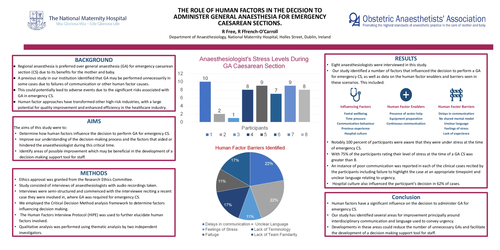
• Our study identified a number of factors that influenced the decision to perform a GA for emergency CS, as well as data on the human factor enablers and barriers seen in these scenarios. This included:
•Notably 100 percent of participants were aware that they were under stress at the time of emergency CS.
•With 75% of the participants rating their level of stress at the time of a GA CS was greater than 8.
•An instance of poor communication was reported in each of the clinical cases recited by the participants including failure to highlight the case at an appropriate timepoint and unclear language relating to urgency.
• Hospital culture also influenced the participant’s decision in 62% of cases.
Conclusion
•Human factors have a significant influence on the decision to administer GA for emergency CS.
•Our study has identified several areas for improvement principally around interdisciplinary communication and language used to convey urgency.
•Developments in these areas could reduce the number of unnecessary GAs and facilitate the development of a decision making support tool for staff.