191 posters, 5 topics, 20 sessions, 393 authors, 116 institutions
ePostersLive by SciGen Technologies S.A. All rights reserved.
Obstetric Anaesthesia Annual Scientific Meeting 2023
18 - 19 May, 2023 | EICC Edinburgh

5808591
Observational study of peripheral skin temperature measurement methods following spinal anaesthesia for caesarean delivery (CD)
Poster Presenter
Authors
Affiliations
Part of Topic
Original Research
Observational study of peripheral skin temperature measurement methods following spinal anaesthesia for caesarean delivery (CD)
Davenport G, Kessack LK, McGlennan C, Bamber J, on behalf of the Rosie Obstetric Anaesthetists’ Research Group*
The Rosie Hospital, Cambridge, UK.
Introduction: Parturients’ feet temperature differences during labour epidural analgesia (LEA) are associated with unsatisfactory analgesia1. Temperature differences can be discriminated by palpation of the parturients’ feet by the midwife1. As part of regular LEA observations in our hospital midwives assess foot temperatures as either ‘warm’ or ‘cold’ but this is not well done. Thermometer measurements of foot skin temperature may be less subjective. We investigated foot skin temperature changes following spinal anaesthesia to see whether the tympanic thermometer commonly available on labour wards, could be usefully repurposed to assess skin temperature of the dorsum of the foot.
Methods: Between 23/08/21 and 19/12/22, as part of a larger single centre, prospective observational study with ethics committee approval, 60 healthy parturients with singleton pregnancy and normal placental position scheduled for category 4 CD with ‘single-shot’ spinal anaesthesia were recruited to have the skin temperature measured on the dorsum of both feet with skin thermistors (Covidien Mon-a-Therm©) and infrared tympanic thermometer (Braun Welch Allyn).
Paired temperature measurements started immediately prior to intrathecal injection and every minute after injection until start of surgery. Intrathecal 0.5% hyperbaric bupivacaine with diamorphine was the standard injection. Data was entered into MS Excel and StatPlus:mac used to derive Bland Altman plots, coefficient of reproducibility and Pearson correlation.
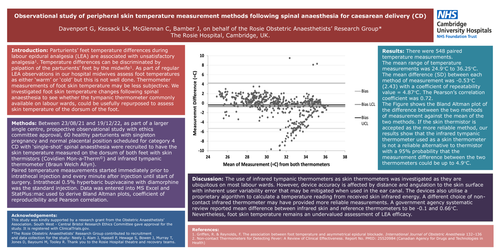
Results: There were 548 paired temperature measurements.
The mean range of temperature measurements was 24.9°C to 36.25°C. The mean difference (SD) between each method of measurement was -0.53°C (2.43) with a coefficient of repeatability value = 4.87°C. The Pearson’s correlation coefficient was 0.72.
The Figure shows the Bland Altman plot of the difference between the two methods of measurement against the mean of the two methods. If the skin thermistor is accepted as the more reliable method, our results show that the infrared tympanic thermometer used as a skin thermometer is not a reliable alternative to thermistor with a 95% probability that the measurement difference between the two thermometers could be up to 4.9°C.
Discussion: The use of infrared tympanic thermometers as skin thermometers was investigated as they are ubiquitous on most labour wards. However, device accuracy is affected by distance and angulation to the skin surface with inherent user variability error that may be mitigated when used in the ear canal. The devices also utilise a proprietary algorithm to calculate a temperature reading from received skin infrared energy. A different choice of non-contact infrared thermometer may have provided more reliable measurements. A government agency systematic review reported mean difference between infrared skin and reference thermometers to be -0.1 and 0.66°C. Nevertheless, foot skin temperature remains an undervalued assessment of LEA efficacy.
Acknowledgements:
This study was kindly supported by a research grant from the Obstetric Anaesthetists’ Association. South West - Central Bristol Research Ethics Committee gave approval for the study. It is registered with ClinicalTrials.gov.
*The Rosie Obstetric Anaesthetists’ Research Group contributed to recruitment
and data collection for the study: Neely J, Alam J, Hassell P, Hewage S, Bowen J, Murray T, Jones D, Bayoumi M, Tooley R. Thank you to the Rosie Hospital theatre and recovery teams.
References:
1. Griffen, R. & Reynolds, F. The association between foot temperature and asymmetrical epidural blockade. International Journal of Obstetric Anesthesia 132–136
2. Non-contact Thermometers for Detecting Fever: A Review of Clinical Effectiveness. Report No. PMID: 25520984 (Canadian Agency for Drugs and Technologies in Health)