191 posters, 5 topics, 20 sessions, 393 authors, 116 institutions
ePostersLive by SciGen Technologies S.A. All rights reserved.
Obstetric Anaesthesia Annual Scientific Meeting 2023
18 - 19 May, 2023 | EICC Edinburgh

5799151
Equitable care: identifying racial disparities in epidural analgesia
Poster Presenter
Authors
Part of Topic
Service Evaluation
Equitable care: identifying racial disparities in epidural analgesia
Dr Julia Blackburn, Dr Lucinda Williams, Dr Emma Plunkett, Dr James Geoghegan, Dr Victoria Hodgetts Morton
Birmingham Women's and Children's NHS Foundation Trust
Introduction Twice as many ethnic minority women report concerns about pain and discomfort during labour as White women [1]. Disparities have been described in the use of epidural analgesia: ethnic minority women are less likely to receive neuraxial labour analgesia than non-minority White women [2]. This service evaluation project aims to explore local experience of this, as well as reasons behind any discrepancies.
Methods Analysis of the ethnic categories of women who received epidural analgesia over a one year period (September 2021– 2022) at Birmingham Women's Hospital, UK. This was compared (using Chi-squared test) to the ethnic categories of all women who had given birth by any route (over 24 weeks gestation) during that time. Elective caesarean births were excluded from both groups. First language and need for interpreter were also analysed.
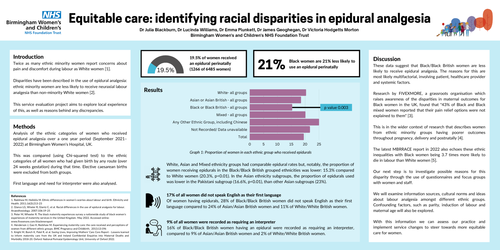
White, Asian and Mixed ethnicity groups had comparable epidural rates but, notably, the proportion of women receiving epidurals in the Black/Black British grouped ethnicities was lower: 15.3% compared to White women (20.3%, p<0.01). In the Asian ethnicity subgroups, the proportion of epidurals used was lower in the Pakistani subgroup (16.6%, p<0.01), than other Asian subgroups (23%)
17% of all women did not speak English as their first language Of women having epidurals, 28% of Black/Black British women did not speak English as their first language compared to 24% of Asian/Asian British women and 11% of White/White British women.
9% of all women were recorded as requiring an interpreter 16% of Black/Black British women having an epidural were recorded as requiring an interpreter, compared to 9% of Asian/Asian British women and 2% of White/White British women.
Discussion These data suggest that Black/Black British women are less likely to receive epidural analgesia. The reasons for this are most likely multifactorial, involving patient, healthcare provider and systemic factors. Research by FIVEXMORE, a grassroots organisation which raises awareness of the disparities in maternal outcomes for Black women in the UK, found that "43% of Black and Black mixed women reported that their pain relief options were not explained to them" [3]. This is in the wider context of research that describes women from ethnic minority groups having poorer outcomes throughout pregnancy, delivery and postnatally [4]. The latest MBRRACE report in 2022 also echoes these ethnic inequalities with Black women being 3.7 times more likely to die in labour than White women [5]. Our next step is to investigate possible reasons for this disparity through the use of questionnaires and focus groups with women and staff. We will examine information sources, cultural norms and ideas about labour analgesia amongst different ethnic groups. Confounding factors, such as parity, induction of labour and maternal age will also be explored. With this information we can assess our practice and implement service changes to steer towards more equitable care for women.