191 posters, 5 topics, 20 sessions, 393 authors, 116 institutions
ePostersLive by SciGen Technologies S.A. All rights reserved.
Obstetric Anaesthesia Annual Scientific Meeting 2023
18 - 19 May, 2023 | EICC Edinburgh

5798448
Testing spinal block for elective caesarean section: is the OAA standard fit for clinical practice?
Poster Presenter
Authors
Part of Topic
Service Evaluation
The OAA have recently produced guidance on testing the block for Caesarean Section, recommending a light touch block to T5 or higher and the inability to straight leg raise (Bromage Score 3) as indicative of an effective block .[1]
This audit of current practice at a large tertiary obstetric centre reviewed the block levels obstetric anaesthetists considered fit for surgery and their correlation with the published standard and incidence of intra-operative pain.
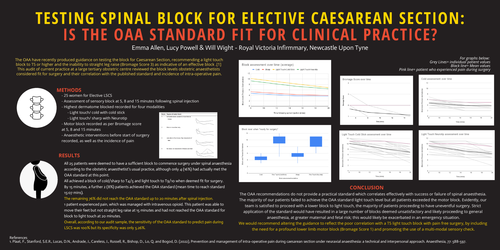
25 women for Elective LSCS
- Assessment of sensory block at 5, 8 and 15 minutes following spinal injection
- Highest dermatome blocked recorded for four modalities
- Light touch/ cold with cold stick
- Light touch/ sharp with Neurotip
- Motor block recorded as per Bromage score at 5, 8 and 15 minutes
- Anaesthetic interventions before start of surgery recorded, as well as the incidence of pain
All 25 patients were deemed to have a sufficient block to commence surgery under spinal anaesthesia according to the obstetric anaesthetist's usual practice, although only 4 (16%) had actually met the OAA standard at this point.
All achieved a block of cold/sharp to T4/5 and light touch to T9/10 when deemed fit for surgery.
By 15 minutes, a further 2 (8%) patients achieved the OAA standard (mean time to reach standard 15:07 mins).
The remaining 76% did not reach the OAA standard up to 20 minutes after spinal injection.
1 patient experienced pain, which was managed with intravenous opioid. This patient was able to move their feet but not straight leg raise at 15 minutes and had not reached the OAA standard for block to light touch at 20 minutes.
Overall, according to our audit sample, the sensitivity of the OAA standard to predict pain during LSCS was 100% but its specificity was only 5.26%.
The OAA recommendations do not provide a practical standard which correlates effectively with success or failure of spinal anaesthesia. The majority of our patients failed to achieve the OAA standard light touch level but all patients exceeded the motor block. Evidently, our team is satisfied to proceed with a lower block to light touch, the majority of patients proceeding to have uneventful surgery. Strict application of the standard would have resulted in a large number of blocks deemed unsatisfactory and likely proceeding to general anaesthesia, at greater maternal and fetal risk; this would likely be exacerbated in an emergency situation.
We would recommend altering the guidance to reflect the poor correlation with a T5 light touch block with pain free surgery, by including the need for a profound lower limb motor block (Bromage Score 1) and promoting the use of a multi-modal sensory check.