Loading...

191 posters, 5 topics, 20 sessions, 393 authors, 116 institutions

ePostersLive by SciGen Technologies S.A. All rights reserved.

5797685

Anaesthetic, maternal and neonatal outcomes in pregnant patients with mitral stenosis
Poster Presenter

Galvin Gan

Part of Topic

Service Evaluation

INTRODUCTION

•The recent confidential enquiry into maternal mortality highlighted that 13% of cardiac deaths were caused by valvular heart disease (VHD).[1]

•Mitral stenosis (MS) is the most common VHD and is associated with significant maternal morbidity and mortality.[2]
 

AIMS

•To describe the characteristics, maternal, neonatal and cardiac outcomes of parturients with mitral stenosis (MS) managed by our pregnancy heart team.


METHODS

•Electronic records of all parturients diagnosed with MS from 2015 to 2021 at our tertiary unit were reviewed.

•We compared findings of  patients with mild or moderate MS with those presenting with a severe lesion based on the mitral valve (MV) area. Data was analysed using Mann-Whitney U and Fisher exact statistics with p<0.05 is considered significant.


RESULTS

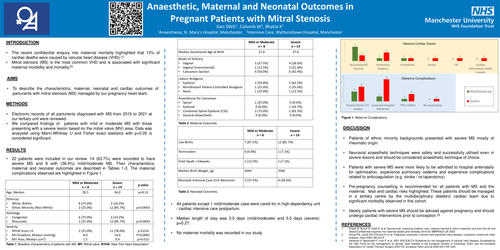
•22 patients were included in our review. 14 (63.7%) were recorded to have severe MS and 8 with (36.4%) mild/moderate MS. Their characteristics, maternal and neonatal outcomes are described in Tables 1-3. The maternal complications observed are highlighted in Figure 1.
 
•All patients except 1 mild/moderate case were cared for in high-dependency unit / cardiac intensive care postpartum.
 
•Median length of stay was 3.5 days (mild/moderate) and 5.5 days (severe); p=0.27.
 
•No maternal mortality was recorded in our study.
 

DISCUSSION

•Patients of ethnic minority backgrounds presented with severe MS mostly of rheumatic origin.

•Neuraxial anaesthetic techniques were safely and successfully utilised even in severe lesions and should be considered anaesthetic technique of choice.

•Patients with severe MS were more likely to be admitted to hospital antenatally for optimisation, experience pulmonary oedema and experience complications related to anticoagulation (e.g. stroke / re-laparotomy).

•Pre-pregnancy counselling is recommended for all patients with MS and the maternal,  fetal and cardiac risks highlighted. These patients should be managed in a tertiary centre by the multidisciplinary obstetric cardiac team due to significant morbidity observed in this cohort.

•Ideally, patients with severe MS should be advised against pregnancy and should undergo cardiac interventions prior to conception.[3]


REFERENCES

1.Knight M, Bunch K, Patel R, et al. Saving lives, improving mothers’ care: Lessons learned to inform maternity care from the UK and Ireland confidential enquiries into maternal deaths and morbidity 2018-20. MBRRACE-UK 2022.
2.Ducas RA, Javier DA, D’Souza R, et al. Pregnancy outcomes in women with significant valve disease: a systemic review and meta-analysis. Heart 2020;106:512-9.
3.Vahanian A, Beyersdorf F, Praz F, et al. 2021 ESC/EACTS Guidelines for the management of valvular heart disease: Developed by the Task Force for the management of valvular heart disease of the European Society of Cardiology (ESC) and the European Association for Cardio-Thoracic Surgery (EACTS), European Heart Journal 2022;43(7):561-632.
Obstetric Anaesthesia Annual Scientific Meeting 2023 » banner
Copyright © 2015-2026, ePostersLive® SciGen is a registered trademark of SciGen Technologies S.A. Patent pending.

This website and third-party tools we use rely on cookies for the best user experience. By selecting "I agree", you agree to cookie usage as described in our Privacy Policy.
