191 posters, 5 topics, 20 sessions, 393 authors, 116 institutions
ePostersLive by SciGen Technologies S.A. All rights reserved.
Obstetric Anaesthesia Annual Scientific Meeting 2023
18 - 19 May, 2023 | EICC Edinburgh

5794456
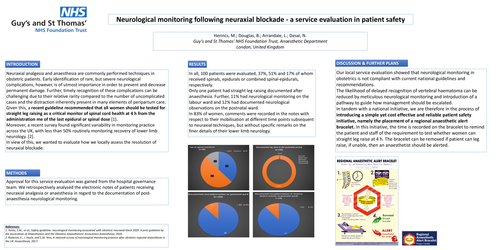
Neurological monitoring following neuraxial blockade - a service evaluation in patient safety
Poster Presenter
Part of Topic
Service Evaluation
Introduction: Neuraxial analgesia and anaesthesia are commonly performed techniques in obstetric patients. Early identification of rare, but severe neurological complications, however, is of utmost importance in order to prevent and decrease permanent damage. Further, timely recognition of these complications can be challenging due to their relative rarity compared to the number of uncomplicated cases and the distraction inherently present in many elements of peripartum care. Given this, a recent guideline recommended that all women should be tested for straight leg raising as a critical monitor of spinal cord health at 4 h from the administration me of the last epidural or spinal dose [1]. Moreover, a recent survey found significant variability in monitoring practice across the UK, with less than 50% routinely monitoring recovery of lower limb neurology. [2]. In view of this, we wanted to evaluate how we locally assess the resolution of neuraxial blockade.
Methods: Approval for this service evaluation was gained from the hospital governance team. We retrospectively analysed the electronic notes of patients receiving neuraxial analgesia or anaesthesia in regard to the documentation of post-anaesthesia neurological monitoring.
Results: In all, 100 patients were evaluated, 37%, 51% and 17% of whom received spinals, epidurals or combined spinal-epidurals, respectively. Only one patient had straight leg raising documented after anaesthesia. Further, 11% had neurological monitoring on the labour ward and 12% had documented neurological observations on the postnatal ward. In 83% of women, comments were recorded in the notes with respect to their mobilisation at different time points subsequent to neuraxial techniques, but without specific remarks on the finer details of their lower limb neurology.
Discussion and further plans:
Our local service evaluation showed that neurological monitoring in obstetrics is not compliant with current national guidelines and recommendations. The likelihood of delayed recognition of vertebral haematoma can be reduced by meticulous neurological monitoring and introduction of a pathway to guide how management should be escalated. In tandem with a national initiative, we are therefore in the process of introducing a simple yet cost effective and reliable patient safety initiative, namely the placement of a regional anaesthetic alert bracelet. In this initiative, the time is recorded on the bracelet to remind the patient and staff of the requirement to test whether women can straight leg raise at 4 h. The bracelet can be removed if patient can leg raise, if unable, then an anaesthetist should be alerted.
References:
1. Yentis, S.M., et al., Safety guideline: neurological monitoring associated with obstetric neuraxial block 2020: A joint guideline by the Association of Anaesthetists and the Obstetric Anaesthetists' Association.Anaesthesia, 2020.
2. Roderick, E., J. Hoyle, and S.M. Yens, A national survey of neurological monitoring practice after obstetric regional anaesthesia in the UK. Anaesthesia, 2017.