191 posters, 5 topics, 20 sessions, 393 authors, 116 institutions
ePostersLive by SciGen Technologies S.A. All rights reserved.
Obstetric Anaesthesia Annual Scientific Meeting 2023
18 - 19 May, 2023 | EICC Edinburgh

5792371
Evaluation of the Accuro in obstetrics
Poster Presenter
Authors
Affiliations
Part of Topic
Service Evaluation
Evaluation of the Accuro in obstetrics
M. Chillal, M. Herincs, K. Hunter, N. Desai
Guy’s and St Thomas’ NHS Foundation Trust
Introduction
Preprocedural neuraxial ultrasound has been demonstrated to improve neuraxial puncture success rate, by identifying optimal interspace insertion, and decreasing the number of needle redirections. It is also associated with improvement in the first pass rate(1, 2).
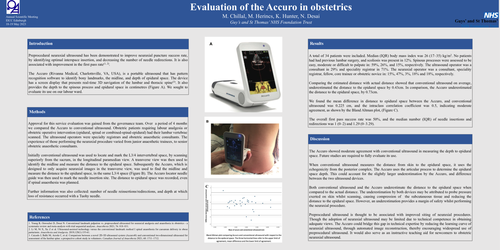
The Accuro (Rivanna Medical, Charlottsville, VA, USA), is a portable ultrasound that has pattern recognition software to identify bony landmarks, the midline, and depth of epidural space. The device has a screen display that presents real-time 3D navigation of the lumbar and thoracic spine(3). It also provides the depth to the spinous process and epidural space in centimetres (Figure A). We sought to evaluate its use on our labour ward.
Method
Approval for this service evaluation was gained from the governance team. Over a period of 4 months we compared the Accuro to conventional ultrasound. Obstetric patients requiring labour analgesia or obstetric operative intervention (epidural, spinal or combined-spinal-epidural) had their lumbar vertebrae scanned. The ultrasound operators were specialty registrars and obstetric anaesthetic consultants. The experience of those performing the neuraxial procedure varied from junior anaesthetic trainees, to senior obstetric anaesthetic consultants.
Initially conventional ultrasound was used to locate and mark the L3/4 intervertebral space, by scanning superiorly from the sacrum, in the longitudinal paramedian view. A transverse view was then used to identify the midline and measure the distance to the epidural space. Subsequently the Accuro, which is designed to only acquire neuraxial images in the transverse view, was used to find the midline and measure the distance to the epidural space, in the same L3/4 space (Figure B). The Accuro locator needle guide was then used to mark the needle insertion site. The distance to epidural space was recorded, even if spinal anaesthesia was planned.
Further information was also collected: number of needle reinsertions/redirections, and depth at which loss of resistance occurred with a Tuohy needle.