191 posters, 5 topics, 20 sessions, 393 authors, 116 institutions
ePostersLive by SciGen Technologies S.A. All rights reserved.
Obstetric Anaesthesia Annual Scientific Meeting 2023
18 - 19 May, 2023 | EICC Edinburgh

5785685
A retrospective analysis of the impact of ethnicity and preferred spoken language in obstetric anaesthesia
Part of Topic
Service Evaluation
Introduction
There are proven racial inequalities in maternity care (1) including anaesthetic care during childbirth (2). In addition, language barriers can impede effective communication and delivery of equitable care. Research into the impact of ethnicity and language barriers in obstetric anaesthesia is limited. The aims of this study were to describe the demographics of the population using obstetric anaesthetic services and to investigate for inequalities in anaesthetic outcomes based on patient ethnicity and preferred spoken language (PSL) in St Helier hospital, London.
Methods
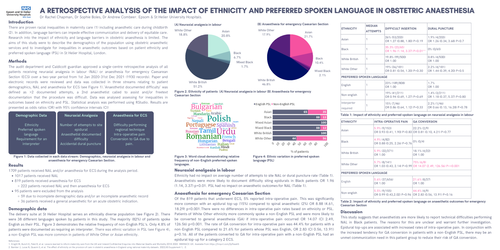
The audit department and Caldicott guardian approved a single-centre retrospective analysis of all patients receiving neuraxial analgesia in labour (NAL) or anaesthesia for emergency Caesarean Section (ECS) over a two-year period from 1st Jan 2020-31st Dec 2021 (1930 records). Paper and electronic records were reviewed and data was collected in three streams relating to patient demographics, NAL and anaesthesia for ECS (see Figure 1). Data was analysed assessing for inequalities in outcomes based on ethnicity and PSL. Statistical analysis was performed using RStudio. Results are presented as odds ratios (OR) with 95% confidence intervals (CI)
Results
1709 patients received NAL and/or anaesthesia for ECS during the analysis period.
- 1017 patients received NAL
- 819 patients received anaesthesia for ECS
- 222 patients received NAL and then anaesthesia for ECS
- 95 patients were excluded from the analysis
- 59 due to incomplete demographic data and/or an incomplete anaesthetic record
- 36 patients received a general anaesthetic for an acute obstetric indication.
Demographic data
The delivery suite at St Helier Hospital serves an ethnically diverse population (see Figure 2). There were 38 different languages spoken by patients in this study. The majority (82%) of patients spoke English as their PSL. Figure 3 demonstrates the relative frequency of non-English preferred spoken languages. Only 4.8% of patients were documented as requiring an interpreter. There was ethnic variation in PSL (see Figure 4), a non-English PSL was more common in patients of White Other or Asian ethnicity.
Neuraxial analgesia in labour
Ethnicity had no impact on average number of attempts to site NAL or dural puncture rate (Table 1). Anaesthetists were more likely to document difficulty performing NAL in Black patients OR 1.96 (1.14, 3.37) p=0.01. PSL had no impact on anaesthetic outcomes for NAL (Table 1).
Anaesthesia for emergency CS
Of the 819 patients that underwent ECS, 5% reported intra-operative pain. This was significantly more common with an epidural top-up (15%) compared to spinal anaesthetic (2%) OR 8.88 (4.61, 18.29) p<0.001.There were no differences in intra-operative pain rates based on ethnicity or PSL. Patients of White Other ethnicity more commonly spoke a non-English PSL and were more likely to be converted to general anaesthesia (GA) if intra-operative pain occurred OR 14.07 (CI 2.49, 126.56) p<0.001. The rate of GA conversion for intra-operative pain was 44.4% for patients with a non-English PSL compared to 21.6% for patients whose PSL was English, OR 2.83 (CI 0.56, 13.91) p=0.16. All of the patients converted to GA for intra-operative pain with a non-English PSL had an epidural top-up for a category 2 ECS.
Discussion
This study suggests that anaesthetists are more likely to report technical difficulties performing NAL in Black patients. The reasons for this are unclear and warrant further investigation. Epidural top-ups are associated with increased rates of intra-operative pain. In conjunction with the increased tendency for GA conversion in patients with a non-English PSL, there may be an unmet communication need in this patient group to reduce their risk of GA conversion.