191 posters, 5 topics, 20 sessions, 393 authors, 116 institutions
ePostersLive by SciGen Technologies S.A. All rights reserved.
Obstetric Anaesthesia Annual Scientific Meeting 2023
18 - 19 May, 2023 | EICC Edinburgh

5814379
Cell salvage baseline confidence and knowledge survey
Poster Presenter
Authors
Part of Topic
Surveys
Cell salvage baseline confidence and knowledge survey
Dr R. Hayes, Dr R. Field, Dr S. Chaudhry, Dr F. Choksey and Dr N. Osborn
Introduction
With national blood product supplies becoming more scarce, Intraoperative Cell Salvage (ICS) is fast becoming a crucial tool in management of intraoperative haemorrhage and contributes significantly to Blood conservation strategies. We conducted a survey at both University Hospital Coventry and Warwickshire (UHCW) and Heartlands Hospital in Birmingham (BHH) to assess baseline knowledge and confidence amongst Anaesthetists in the use of ICS.
Methods
Between September 2022 and October 2022 for UHCW and in January 2023 for BHH, using the SurveyMonkey online surveying tool, 10 questions were sent out to the Anaesthetics Department of both Trusts. These were formulated from the, UK Cell Salvage Action Group’s Intraoperative Cell Salvage Education Workbook [1].
The Following Questions were asked:-
Results
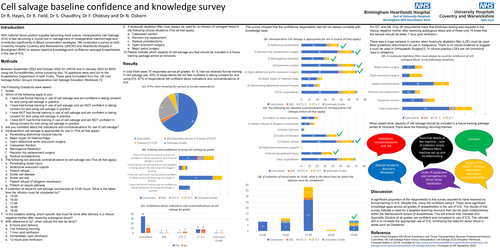
In total there were 70 responses across all grades. 81 % had not received formal training in cell salvage use. 43% of respondents did not feel confident in taking consent for and using ICS. 67% of respondents felt confident about indications and contraindications of ICS.
The survey showed that the confidence respondents had did not always correlate with knowledge base.
For Q7. and Q8. Only 28 respondents knew that Kleihauer testing was required in the rhesus negative mother after receiving autologous blood and of those only 15 knew that the sample should be taken 1 hour post reinfusion.
There was a huge variance in opinion when leukocyte depletion filter (LDF) must be used. Most guidelines recommend its use in malignancy. There is no robust evidence to suggest it must be used in OrthopaedicSurgery[1]. In clinical practice LDFs are not commonly used in obstetrics.
When asked what aspects of cell salvage should be included in a future training package aimed at clinicians, there were the following recurring themes:
Discussion
A significant proportion of the respondents to this survey reported to have received no formal training in ICS. Despite this, many felt confident using it. There were significant knowledge gaps across all grades of anaesthetists in the use of ICS. The results of this survey indicate a need for a targeted teaching resource that can be used collaboratively within the Warwickshire school of anaesthesia. This will ensure that Trainees and Speciality Doctors of all grades are confident and competent to use of ICS. The ultimate aim is to increase the appropriate use of ICS, minimising the need for donor blood in areas such as Obstetrics.
Reference
1. Joint United Kingdom (UK) Blood Transfusion and Tissue Transplantation Services Professional Advisory Committee: UK Cell Salvage Action Group. Intraoperative Cell Salvage (ICS) Education Workbook. Complete Edition 2 (2018). Available at https://www.transfusionguidelines.org/transfusion-practice/uk-cell-salvage-action-group/intraoperative-cell-salvage-education. Accessed on 5th September 2022