191 posters, 5 topics, 20 sessions, 393 authors, 116 institutions
ePostersLive by SciGen Technologies S.A. All rights reserved.
Obstetric Anaesthesia Annual Scientific Meeting 2023
18 - 19 May, 2023 | EICC Edinburgh

5757280
Availability of total intravenous anaesthesia for pregnant people -- a survey of UK practice
Poster Presenter
Authors
Affiliations
Part of Topic
Surveys
Availability of Total Intravenous Anaesthesia(TIVA) for pregnant people – a survey of UK practice
Introduction
•Neuraxial anaesthesia is the preferred method of anaesthesia in obstetrics. General anaesthesia is rarely indicated or chosen by patients.
•Current practice in UK predominantly includes maintenance of anaesthesia with inhalational agents.
•TIVA is underutilised and understudied in the obstetric population [1].
•This survey aims to report current practice of TIVA for obstetric surgery in the UK and to identify obstacles to its wider use.
Method
•We conducted a survey (number 1035) among UK anaesthetists approved by the Obstetric Anaesthetists’ Association (OAA).
•The questionnaire focussed on establishing the current incidence of TIVA use in obstetric surgery and practical factors, such as availability and familiarity of equipment and monitoring.
Results
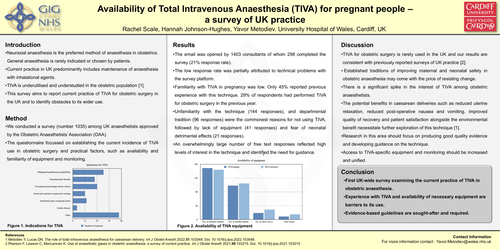
•The email was opened by 1403 consultants of whom 298 completed the survey (21% response rate).
•The low response rate was partially attributed to technical problems with the survey platform.
•Familiarity with TIVA in pregnancy was low. Only 45% reported previous experience with this technique. 29% of respondents had performed TIVA for obstetric surgery in the previous year.
•Unfamiliarity with the technique (144 responses), and departmental tradition (96 responses) were the commonest reasons for not using TIVA, followed by lack of equipment (41 responses) and fear of neonatal detrimental effects (21 responses).
•An overwhelmingly large number of free text responses reflected high levels of interest in the technique and identified the need for guidance.
Discussion
•TIVA for obstetric surgery is rarely used in the UK and our results are consistent with previously reported surveys of UK practice [2].
• Established traditions of improving maternal and neonatal safety in obstetric anaesthesia may come with the price of resisting change.
•There is a significant spike in the interest of TIVA among obstetric anaesthetists.
•The potential benefits in caesarean deliveries such as reduced uterine relaxation, reduced post-operative nausea and vomiting, improved quality of recovery and patient satisfaction alongside the environmental benefit necessitate further exploration of this technique [1].
•Research in this area should focus on producing good quality evidence and developing guidance on the technique.
•Access to TIVA-specific equipment and monitoring should be increased and unified.
Conclusion
•First UK-wide survey examining the current practice of TIVA in obstetric anaesthesia.
•Experience with TIVA and availability of necessary equipment are barriers to its use.
•Evidence-based guidelines are sought-after and required.