191 posters, 5 topics, 20 sessions, 393 authors, 116 institutions
ePostersLive by SciGen Technologies S.A. All rights reserved.
Obstetric Anaesthesia Annual Scientific Meeting 2023
18 - 19 May, 2023 | EICC Edinburgh

5754356
Perioperative management of patients undergoing incidental surgery during pregnancy
Poster Presenter
Part of Topic
Surveys
Perioperative management of patients undergoing incidental surgery during pregnancy
A. McCallum, ST6, Queen Elizabeth University Hospital, Glasgow; R. Kearns, Consultant Anaesthetist, Princess Royal Maternity Hospital, Glasgow
Introduction
An estimated 1-2% of parturients require non-obstetric surgery whilst pregnant [1]. To ensure optimal maternal and neonatal outcomes, pre- and post-operative care must be inter-disciplinary with clear pathways of communication. Intra-operatively, modifications to standard anaesthetic management have been suggested - for example, the Society for Obstetric Anesthesia and Perinatology (SOAP) recommend avoiding sugammadex during pregnancy due to concerns regarding the effects of progesterone encapsulation [2]
Aim
Following the production of a local guideline on incidental surgery in pregnancy, we aimed to assess knowledge and practice of this amongst anaesthetists in our health board.
Methods
We created a hypothetical case of an otherwise well, pregnant woman at 28-weeks gestation requiring laparoscopic appendicectomy. An online survey considering the perioperative management of this patient was then sent on 31/10/22 to all anaesthetists working within NHS Greater Glasgow and Clyde. The survey was open for two weeks, with results compared to recommendations from published literature and local guidelines. Requirement for ethical approval was waived by the local research ethics service. Data are presented as count (%).
Results
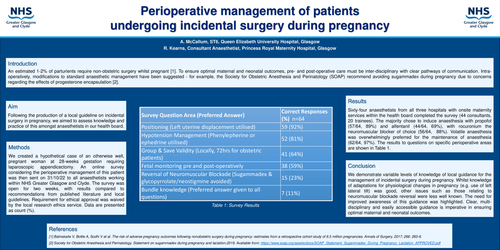
Sixty-four anaesthetists from all three hospitals with onsite maternity services within the health board completed the survey (44 consultants, 20 trainees). The majority chose to induce anaesthesia with propofol (57/64, 89%) and alfentanil (44/64, 69%), with rocuronium the neuromuscular blocker of choice (56/64, 88%). Volatile anaesthesia was overwhelmingly preferred for the maintenance of anaesthesia (62/64, 97%). The results to questions on specific perioperative areas are shown in Table 1.
Conclusion
We demonstrate variable levels of knowledge of local guidance for the management of incidental surgery during pregnancy. Whilst knowledge of adaptations for physiological changes in pregnancy (e.g. use of left lateral tilt) was good, other issues such as those relating to neuromuscular blockade reversal were less well known. The need for improved awareness of this guidance was highlighted. Clear, multi-disciplinary and easily accessible guidance is imperative in ensuring optimal maternal and neonatal outcomes.
References
[1] Balinskaite V, Bottle A, Sodhi V et al. The risk of adverse pregnancy outcomes following nonobstetric surgery during preg
nan cy: estimates from a retrospective cohort study of 6.5 million pregnancies. Annals of Surgery. 2017; 266: 260 6.
[2] Society for Obstetric Anesthesia and Perinatology. Statement on sugammadex during pregnancy and lactation.2019. Available fro m: https://www.soap.org/assets/docs/SOAP_Statement_Sugammadex_During_Pregnancy_Lactation_APPROVED.pdf