191 posters, 5 topics, 20 sessions, 393 authors, 116 institutions
ePostersLive by SciGen Technologies S.A. All rights reserved.
Obstetric Anaesthesia Annual Scientific Meeting 2023
18 - 19 May, 2023 | EICC Edinburgh

5749822
Epidural analgesia during labour - 2021 Regional Hospital Service Quality Survey.
Poster Presenter
Authors
Part of Topic
Surveys
Epidural Analgesia in Labour-
2021 Regional Hospital Service Quality Survey
Dr. Monika Krupova, DESAIC; Dr. Khalid Irshad, Dr. Rory Page, FFARCSI, FJFICMI;
Department of Anaesthesiology, Cavan & Monaghan Hospital, Ireland
Introduction.
Childbirth is one of the most painful experiences a woman can undergo. The degree of pain experienced, and the quality of pain relief affect patients’ satisfaction with the birthing process and may have long-term emotional and psychological effects.
Epidural analgesia is a significant procedure during the labour with specific and potentially serious complications. At Cavan Monaghan Hospital (CMH), we have been providing a 24/7 epidural service for over 20 years.
The aim of this study is to determine the level of maternal satisfaction and the incidence of complications/adverse effects after the administration of epidural/CSE analgesia for labour pain over a period of one year. The results of this study will help us improve the quality of the epidural service provided to patients in the maternity ward.
Methodology.
Data were collected retrospectively for the year 2021 from review forms, completed by an anaesthesiologist after checking the patients within 1 or 2 days of delivery.
The form contained the following information:
1. Verbal level of satisfaction, from excellent to poor
2.Common complications: nausea, vomiting, pruritus, pyrexia, headache, back pain and photophobia
Results and Discussion.
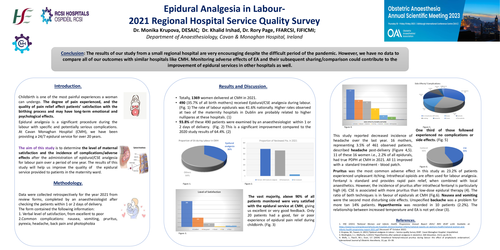
The vast majority, above 90% of all patients monitored were very satisfied with the epidural service at CMH, giving us excellent or very good feedback. Only 20 patients had a good, fair or poor experience of epidural pain relief during childbirth. (Fig. 3)
One third of those followed experienced no complications or side effects. (Fig. 5)
This study reported decreased incidence of headache over the last year. 16 mothers, representing 3.5% of 461 observed patients, described headache post-delivery (Figure 4,5). 11 of these 16 women i.e., 2.2% of all epidurals, had true PDPH at CMH in 2021. All 11 improved with a standard treatment - blood patch.
Pruritus was the most common adverse effect in this study as 23.2% of patients experienced unpleasant itching. Intrathecal opioids are often used for labour analgesia. Fentanyl is standard and provides rapid pain relief, when combined with local anaesthetics. However, the incidence of pruritus after intrathecal fentanyl is particularly high (4). CSE is associated with more pruritus than low-dose epidural therapy (4). The ratio of both techniques is in favour of epidurals at CMH (Fig.6). Nausea and vomiting were the second most disturbing side effects. Unspecified backache was a problem for more tan 14% patients. Hyperthermia was recorded in 10 patients (2.2%). The relationship between increased temperature and EA is not yet clear (3).
Conclusion: The results of our study from a small regional hospital are very encouraging despite the difficult period of the pandemic. However, we have no data to compare all of our outcomes with similar hospitals like CMH. Monitoring adverse effects of EA and their subsequent sharing/comparison could contribute to the improvement of epidural services in other hospitals as well.