191 posters, 5 topics, 20 sessions, 393 authors, 116 institutions
ePostersLive by SciGen Technologies S.A. All rights reserved.
Obstetric Anaesthesia Annual Scientific Meeting 2023
18 - 19 May, 2023 | EICC Edinburgh

5785582
Cardioversion in pregnancy - Lessons for the anaesthetist
Poster Presenter
Authors
Affiliations
Part of Topic
Service Evaluation
Cardioversion in pregnancy – Lessons for the anaesthetist
R. Fishwick, R. Sparke, K. Bhatia
St Mary’s Hospital, Manchester University NHS Foundation Trust, Manchester, UK
Introduction
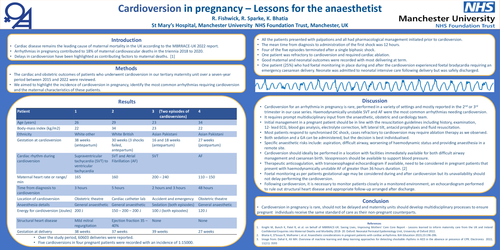
• Cardiac disease remains the leading cause of maternal mortality in the UK according to the MBRRACE-UK 2022 report.
• Arrhythmias in pregnancy contributed to 18% of maternal cardiovascular deaths in the triennia 2018 to 2020.
• Delays in cardioversion have been highlighted as contributing factors to maternal deaths. [1]
Methods
• The cardiac and obstetric outcomes of patients who underwent cardioversion in our tertiary maternity unit over a seven-year period between 2015 and 2022 were reviewed.
• We aimed to highlight the incidence of cardioversion in pregnancy, identify the most common arrhythmias requiring cardioversion and the maternal characteristics of these patients.
Results
[table]
• Over the study period, 60603 deliveries were reported.
• Five cardioversions in four pregnant patients were recorded with an incidence of 1:15000.
• All the patients presented with palpations and all had pharmacological management initiated prior to cardioversion.
• The mean time from diagnosis to administration of the first shock was 12 hours.
• Four of the five episodes terminated after a single biphasic shock.
• One patient was refractory to cardioversion and required cardiac ablation.
• Good maternal and neonatal outcomes were recorded with most delivering at term.
• One patient (25%) who had foetal monitoring in place during and after the cardioversion experienced fetal bradycardia requiring an emergency caesarean delivery. Neonate was admitted to neonatal intensive care following delivery but was safely discharged.
Discussion
• Cardioversion for an arrhythmia in pregnancy is rare, performed in a variety of settings and mostly reported in the 2nd or 3rd trimester in our case series. Haemodynamically unstable SVT and AF were the most common arrhythmias needing cardioversion.
• It requires prompt multidisciplinary input from the anaesthetic, obstetric and cardiology team.
• Initial management in a pregnant patient should be in line with the resuscitation guidelines and including history, examination, a 12- lead ECG, blood gas analysis, electrolyte correction, left lateral tilt, antacid prophylaxis and fluid resuscitation.
• Most patients respond to synchronised DC shock and cases refractory to cardioversion may require ablation therapy as we observed.
• Both sedation and a GA can be administered, but the decision is best individualised.
• Specific anaesthetic risks include: aspiration, difficult airway, worsening of haemodynamic status and providing anaesthesia in a remote environment.
• Cardioversion should ideally be performed in a location with facilities immediately available for both for difficult airway management and caesarean birth.
Vasopressors should be available to support blood pressure.
• Therapeutic anticoagulation, along with transoesophageal echocardiogram if available, need to be considered in pregnant patients that present with haemodynamically unstable AF of greater than 36 hours duration. [2]
• Foetal monitoring as per patients gestational-age may be considered during and after cardioversion but its unavailability should not delay performing the cardioversion.
• Following cardioversion, it is necessary to monitor patients closely in a monitored environment, an echocardiogram performed to rule out structural heart disease and appropriate follow-up arranged after discharge.
Conclusion
• Cardioversion in pregnancy is rare, should not be delayed and maternity units should develop multidisciplinary processes to ensure pregnant individuals receive the same standard of care as their non‐pregnant counterparts.
References
1.Knight M, Bunch K, Patel R, et al. on behalf of MBRRACE-UK. Saving Lives, Improving Mothers' Care Core Report - Lessons learned to inform maternity care from the UK and Ireland Confidential Enquiries into Maternal Deaths and Morbidity 2018- 20. Oxford: Neonatal Perinatal Epidemiology Unit, University of Oxford 2022.
2.Bhatia K, D'Souza R, Malhame I, et al. Anaesthetic considerations in pregnant patients with cardiac arrhythmia. BJA Education 2023;23:196-206.
3. Image from: Dahal K, Ali MH. Overview of machine learning and deep learning approaches for detecting shockable rhythms in AED in the absence or presence of CPR. Electronics 2022; 11(21): 3593