191 posters, 5 topics, 20 sessions, 393 authors, 116 institutions
ePostersLive by SciGen Technologies S.A. All rights reserved.
Obstetric Anaesthesia Annual Scientific Meeting 2023
18 - 19 May, 2023 | EICC Edinburgh

5809714
An evaluation of anaesthesia for abnormally invasive placenta utilising interventional radiology
Poster Presenter
Part of Topic
Service Evaluation
An evaluation of anaesthesia for abnormally invasive placenta utilising interventional radiology
J Whitehouse, K Makam, S Anderson, E Taylor, S Francis
Department of Anaesthesia, University Hospitals of Leicester NHS Trust, Leicester, UK
Introduction
Abnormally invasive placenta (AIP) encompasses a range of disorders resulting from the abnormal invasion of the placental chorionic villi. AIP has the potential for severe maternal and foetal morbidity1. This risk means these patients require a multidisciplinary approach. Considering the global rise in cases of caesarean delivery, the incidence of AIP is increasing. Given this trend we evaluated our anaesthetic practice for such cases, in particular looking at our use of prophylactic occlusion balloon catheters (POBCs) in our tertiary level maternity unit.
Our unit uses a high-risk anaesthetic clinic to discuss anaesthetic technique following AIP diagnosis. Given the complex, often lengthy nature of caesarean delivery in these patients neuraxial blockade +/- general anaesthesia (GA) and invasive vascular lines are often used. Following onset of anaesthesia (where the placenta is suspected to have invaded the bladder) the urological team will place ureteric stents. Our interventional radiology (IR) team will then insert POBCs into the internal iliac arteries. These catheters are inflated following delivery of the baby and have been shown to significantly reduce blood loss in cases of AIP2. However, POBCs have the potential to cause a wide range of complications such as neurological damage, lower limb necrosis, thrombosis, displacement and haematoma. Our service evaluation was designed to look at how we manage our cases of AIP, in particular looking at our rate of complications from POBCs.
Methods
The evaluation took place over a thirteen-year period. Anaesthesia was delivered via spinal, epidural, combined spinal and epidural (CSE), GA or a combination of techniques. POBCs were inserted by our IR team following anaesthesia in the same theatre as the caesarean section was to be performed.
The primary outcome measure was complication rate related to the POBCs, while secondary outcomes included cell salvage, blood loss, duration of surgery, hysterectomy and admission to the intensive care unit (ICU). Statistical analysis was performed to compare the amount of salvaged blood and total blood loss amongst the more popular anaesthetic techniques. All other secondary outcomes were evaluated using their mean, median or percentage.
Results
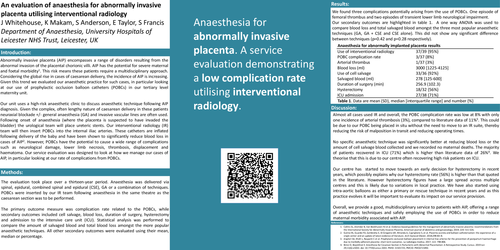
We found three complications potentially arising from the use of POBCs. One episode of femoral thrombus and two episodes of transient lower limb neurological impairment.
Our secondary outcomes are highlighted in table 1. A one way ANOVA was used to compare blood loss and total salvaged blood amongst the three most popular anaesthetic techniques (GA, GA + CSE and CSE alone). This did not show any significant difference between techniques (p=0.42 and p=0.28 respectively).
Discussion
Almost all cases used IR and overall, the POBC complication rate was low at 8% with only one incidence of arterial thrombosis (3%), compared to literature data of 11%3. This could be due to our POBC being placed in situ without the need to move to an IR suite, thereby reducing the risk of malposition in transit and reducing operating times.
No specific anaesthetic technique was significantly better at reducing blood loss or the amount of cell salvage blood collected and we recorded no maternal deaths. The majority of patients recovered in ICU (71%) which is higher than literature data of 26%4. We theorise that this is due to our centre often recovering high risk patients on ICU.
Our centre has started to move towards an early decision for hysterectomy in recent years, which possibly explains why our hysterectomy rate (56%) is higher than that quoted in the literature. However hysterectomy figures have a large spread across multiple centres and this is likely due to variations in local practice. We have also started using intra-aortic balloons as either a primary or rescue technique in recent years and as this practice evolves it will be important to evaluate its impact on our service provision.
Overall, we provide a good, multidisciplinary service to patients with AIP, offering a range of anaesthetic techniques and safely employing the use of POBCs in order to reduce maternal morbidity associated with AIP.