191 posters, 5 topics, 20 sessions, 393 authors, 116 institutions
ePostersLive by SciGen Technologies S.A. All rights reserved.
Obstetric Anaesthesia Annual Scientific Meeting 2023
18 - 19 May, 2023 | EICC Edinburgh

5809383
Obstetric Admissions to the Intensive Care Unit in Malta over a six year period (2016-2021)
Poster Presenter
Authors
Kristina Duca, Nicole Attard, Petramay Attard Cortis, Glenn Paul Abela
Affiliations
Part of Topic
Service Evaluation
Title: Obstetric Admissions to the Intensive Care Unit in Malta over a six year period (2016-2021)
Authors: Duca, Kristina; Attard, Nicole; Attard Cortis, Petramay; Abela, Glenn Paul
Introduction
- A retrospective review of obstetric admissions to Mater Dei Hospital’s (MDH) Intensive Care Unit (ICU) over a 6 year period.
- Malta has 1 main public hospital, with 1 Intensive Care Unit (ICU) which has a total of 20 beds.
- There is no obstetric high dependency unit (HDU).
- •The ICU caters for all medical, surgical and obstetric patients, above 3 years of age, requiring Level 2 care or above.
Methodology
- Permission was granted by the relevant departments.
- Patients were recruited by going through the ICU admissions database for the years 2016 to 2021.
- Inclusion Criteria: Pregnant patients admitted to the ICU during any trimester and up to 30 days post-partum.
- Medical notes were reviewed retrospectively.
- The data collected included patient demographics, obstetric history, reason for admission to ICU with related parameters, management including the need for surgery, length of ICU and hospital stays and maternal outcome.
- Data was inputted and analysed using Microsoft Excel©.
Results
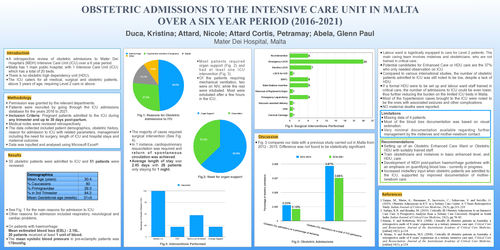
- 55 obstetric patients were admitted to ICU and 51 patients were reviewed.
- See Fig. 1 for the main reasons for admission to ICU.
- Other reasons for admission included respiratory, neurological and cardiac problems
- On patients with haemorrhage: Mean estimated blood loss (EBL) - 2.16L. 20 patients received at least 1 unit of blood.
- The mean systolic blood pressure in pre-eclamptic patients was 179mmHg.
- Most patients required organ support (Fig. 2) and had at least one ICU intervention (Fig. 3)
- Of the patients requiring mechanical ventilation, two were on NIV, while the rest were intubated. Most were extubated after a few hours in the ICU.
- The majority of cases required surgical intervention (See Fig. 4).
- In 1 instance, cardiopulmonary resuscitation was required and return of spontaneous circulation was achieved.
- Average length of stay was 2.45 days with 28 patients only staying for 1 night.
Discussion
- Fig. 5 compares our data with a previous study carried out in Malta from 2012 - 2015. Difference was not found to be statistically significant.
- Labour ward is logistically equipped to care for Level 2 patients. The main caring team involves midwives and obstetricians, who are not trained in critical care.
- Potential candidates for Enhanced Care or HDU care are the 37% who only needed observation on ICU.
- Compared to various international studies, the number of obstetric patients admitted to ICU was still noted to be low, despite a lack of HDU.
- If a formal HDU were to be set up and labour ward staff trained in critical care, the number of admissions to ICU could be even lower, thus further reducing the burden on the limited ICU beds in Malta.
- Most of the hypertension cases brought to the ICU were noted to be the ones with associated seizures and other complications.
- NO maternal deaths were reported.
Limitations
- Missing data of 4 patients.
- Most of the blood loss documentation was based on visual estimation.
- Very minimal documentation available regarding further management by the midwives and mother-newborn contact.
Recommendations
- Setting up of an Obstetric Enhanced Care Ward or Obstetric HDU with suitably trained staff.
- Train obstetricians and midwives in basic enhanced level, and HDU, care.
- Development of MDH post-partum haemorrhage guidelines with an emphasis on quantifying blood loss - currently in progress.
- Increased midwifery input when obstetric patients are admitted to the ICU, supported by improved documentation of mother-newborn care.