191 posters, 5 topics, 20 sessions, 393 authors, 116 institutions
ePostersLive by SciGen Technologies S.A. All rights reserved.
Obstetric Anaesthesia Annual Scientific Meeting 2023
18 - 19 May, 2023 | EICC Edinburgh

5809366
The Influence of Epidural Analgesia on Systolic Blood Pressure, Obstetrical and Neonatal outcomes of Pregnant Women with Valvular Heart Disease
Part of Topic
Original Research
Introduction:
•The frequency of cardiac disease in pregnancy varies from 1% to 4%, and the number is increasing in the western world.
•The incidence of pregnancy, associated with high risk of cardiovascular disease, is increasing in association with delayed childbearing (1).
•Therefore, the use of epidural anesthesia can blunt many of the hemodynamic alterations associated with delivery (2).
•Our objective was to evaluate the effect of epidural analgesia on systolic blood pressure, obstetrical and neonatal outcomes during delivery of women with valvular heart disease.
Materials and methods:
•A retrospective study of 54 women with valvular heart disease (VHD) that gave birth at the Hospital of Lithuanian University of Health Sciences Kaunas Clinics from 2017 to 2020 was performed.
•The following data were analyzed: age, gestational age, VHD, first recorded systolic blood pressure (sBP), the maximal recorded sBP, obstetrical outcomes (spontaneous vaginal delivery rate, blood loss), neonatal outcomes (Apgar score and pH of umbilical cord).
•Patients were divided into two groups: epidural group (E) and no-epidural group (NE).
•Quantitative variables were described as mean±standard deviation or median (interquartile range).
•Differences between the groups were analyzed using χ2 test of independence, Student's t and Mann Whitney’s U tests and considered statistically significant when p<0.05.
Results:
•The mean age was 29.02±5.42 years old and gestational age 39 (2) weeks.
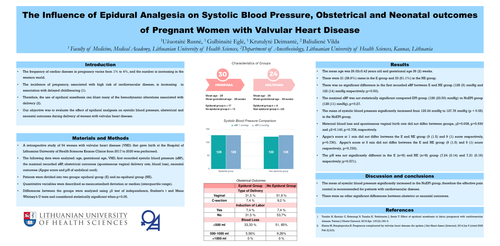
•There were 21 (38.9%) cases in the E group and 33 (61.1%) in the NE group.
•There was no significant difference in the first recorded sBP between E and NE group (128 (9) mmHg and 122 (14) mmHg respectively; p=0.50).
•The maximal sBP was not statistically significant compared EPI group (128 (23.50) mmHg) vs NoEPI group (128 (11) mmHg), p=0.27.
•The mean of systolic blood pressure significantly increased from 125.24 mmHg to 127.76 mmHg (p < 0.05) in the NoEPI group.
•Maternal blood loss and spontaneous vaginal birth rate did not differ between groups, χ2=0.008, p=0.930 and χ2=0.140, p=0.708, respectively.
•Apgar's score at 1 min did not differ between the E and NE group (9 (1.5) and 9 (1) score respectively, p=0.730). Apgar’s score at 5 min did not differ between the E and NE group (9 (1.5) and 9 (1) score respectively, p=0,730).
•The pH was not significantly different in the E (n=8) and NE (n=8) group (7.24 (0.14) and 7.21 (0.19) respectively; p=0.571).
Discussion and conclusions:
•The mean of systolic blood pressure significantly increased in the NoEPI group, therefore the effective pain control is recommended for patients with cardiovascular disease.
•There were no other significant differences between obstetric or neonatal outcomes.