191 posters, 5 topics, 20 sessions, 393 authors, 116 institutions
ePostersLive by SciGen Technologies S.A. All rights reserved.
Obstetric Anaesthesia Annual Scientific Meeting 2023
18 - 19 May, 2023 | EICC Edinburgh

5809201
Programmed intermittent epidural bolus: a national survey of PIEB use and problems encountered.
Poster Presenter
Authors
Affiliations
Part of Topic
Surveys
Programmed intermittent epidural bolus: a national survey of PIEB use and problems encountered.
A Bell, A Meagher, C Canavan, M Melvin. Mayo University Hospital, Mayo, Ireland
Introduction:
Programmed Intermittent Epidural Bolus (PIEB) is a technique in which local anaesthetic medication is delivered via epidural catheter in intermittent boluses at designated time intervals. This programme is moving into favour internationally, away from Continuous Epidural Infusion (CEI) alone. A 2018 meta-analysis concluded that PIEB was associated with better maternal satisfaction and lower doses of total local anaesthetic. (1) In anticipation of introducing PIEB in our department, we conducted a national survey to provide an understanding of the current use of PIEB analgesia in all obstetric anaesthesia departments in Ireland.
Methods:
We designed a 12-question survey using Survey Monkey. As no patient data nor hospital statistics were requested, ethical approval was not required. The survey was sent to anaesthetists from each of the maternity units in the Republic of Ireland (ROI). It was circulated in December 2022 and again in January 2023 to capture missing data. Aspects surveyed were: PIEB use, pump manufacturer, drug concentrations, bolus volumes, timing intervals, use of concomitant Patient Controlled Epidural Analgesia (PCEA) with volume and timing intervals, and if problems arose in the transition to PIEB.
Results:
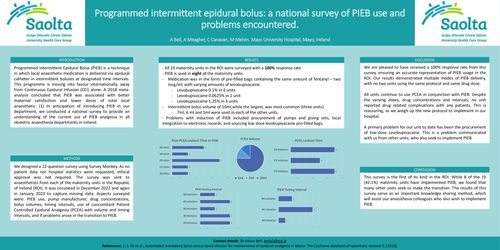
- All 19 maternity units in the ROI were surveyed with a 100% response rate.
- PIEB is used in eight of the maternity units.
- Problems with induction of PIEB included procurement of pumps and giving sets, local integration to electronic records, and sourcing low dose levobupivacaine pre-filled bags.
Discussion:
We are pleased to have received a 100% response rate from this survey, ensuring an accurate representation of PIEB usage in the ROI. Our results demonstrated multiple modes of PIEB delivery, with no two units using the same protocol and same drug dose.
All units continue to use PCEA in conjunction with PIEB. Despite the varying doses, drug concentrations and intervals, no unit reported drug related complications with any patients. This is reassuring, as we weigh up the new protocol to implement in our hospital.
A primary problem for our unit to date has been the procurement of low-dose Levobupivacaine. This is a problem communicated with us from other units, who also seek to implement PIEB.
Conclusion:
This survey is the first of its kind in the ROI. While 8 of the 19 (42.1%) maternity units have implemented PIEB, we found that many other units seek to make the transition. The results of this survey serve as an important knowledge sharing method, which will assist our anaesthesia colleagues who also wish to implement PIEB.
Contact details: Dr Alison Bell, bella1@tcd.ie
References: 1. S. BL et al., Automated mandatory bolus versus basal infusion for maintenance of epidural analgesia in labour. The Cochrane database of systematic reviews 5, (2018)