191 posters, 5 topics, 20 sessions, 393 authors, 116 institutions
ePostersLive by SciGen Technologies S.A. All rights reserved.
Obstetric Anaesthesia Annual Scientific Meeting 2023
18 - 19 May, 2023 | EICC Edinburgh

5808872
Parturient weight: is the problem getting bigger?
Poster Presenter
Authors
Affiliations
Part of Topic
Service Evaluation
Parturient Weight. Is the problem getting bigger?
Introduction
The prevalence of obesity (BMI >30) is rising globally. In the UK, almost a quarter of the antenatal population is obese, with associated implications for obstetric anaesthetists [1,2]. A 2005 study at the Princess Royal Maternity Hospital (PRMH) reported an obesity prevalence of 18.9% at booking with mean BMI 25.5 kg/m², an increase from 24.6 kg/m² in 1990 [3]. We report parturients’ weights at PRMH and describe changing trends over the intervening 20 years.
Methods
Caldicott Guardian approval was obtained. Retrospective data was collected from women delivering at PRMH in May and October 2021 and 2022, using BadgerNetTM (Clevermed, UK), including maternal age; booking weight and BMI; smoking status; Scottish Index of Multiple Deprivation (SIMD) decile; ethnicity; and mode of delivery. Statistical analyses were performed using Microsoft Excel.
Results
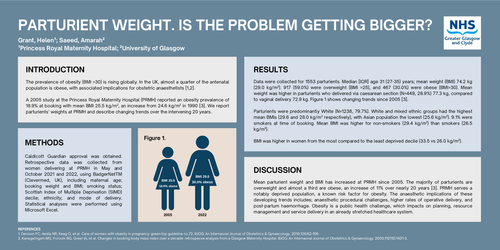
Data were collected for 1553 parturients. Median [IQR] age 31 (27-35) years; mean weight (BMI) 74.2 kg (29.0 kg/m²). 917 (59.0%) were overweight (BMI >25), and 467 (30.0%) were obese (BMI>30). Mean weight was higher in parturients who delivered via caesarean section (N=449, 28.9%) 77.3 kg, compared to vaginal delivery 72.9 kg. Figure 1 shows changing trends since 2005 [3]. Parturients were predominantly White (N=1238, 79.7%). White and mixed ethnic groups had the highest mean BMIs (29.6 and 28.0 kg/m² respectively), with Asian population the lowest (25.6 kg/m²). 9.1% were smokers at time of booking. Mean BMI was higher for non-smokers (29.4 kg/m²) than smokers (26.5 kg/m²). BMI was higher in women from the most compared to the least deprived decile (33.5 vs 26.0 kg/m²).
Discussion
Mean parturient weight and BMI has increased at PRMH since 2005. The majority of parturients are overweight and almost a third are obese, an increase of 11% over nearly 20 years [3]. PRMH serves a notably deprived population, a known risk factor for obesity. The anaesthetic implications of these developing trends includes; anaesthetic procedural challenges, higher rates of operative delivery, and post-partum haemorrhage. Obesity is a public health challenge, which impacts on planning, resource management and service delivery in an already stretched healthcare system.