191 posters, 5 topics, 20 sessions, 393 authors, 116 institutions
ePostersLive by SciGen Technologies S.A. All rights reserved.
Obstetric Anaesthesia Annual Scientific Meeting 2023
18 - 19 May, 2023 | EICC Edinburgh

5808573
Paramedian approach in neuraxial anaesthesia - a national survey
Poster Presenter
Authors
Affiliations
Part of Topic
Surveys
Introduction
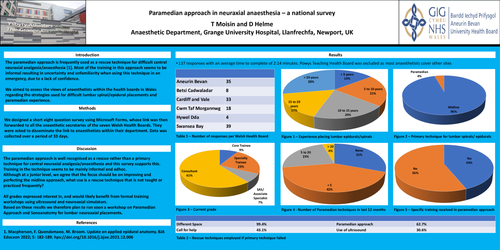
The paramedian approach is frequently used as a rescue technique for difficult central neuraxial analgesia/anaesthesia [1]. Most of the training in this approach seems to be informal resulting in uncertainty and unfamiliarity when using this technique in an emergency, due to a lack of confidence. We aimed to assess the views of anaesthetists within the health boards in Wales regarding the strategies used for difficult lumbar spinal/epidural placements and paramedian experience.
Methods
We designed a short eight question survey using Microsoft Forms, whose link was then forwarded to all the anaesthetic secretaries of the seven Welsh Health Boards. They were asked to disseminate the link to anaesthetists within their department. Data was collected over a period of 33 days.
Results
We obtained 137 responses from six out of the seven health boards. Of the respondents, more than half were Consultants (61%), a third were Trainees (32%) and the rest were SAS (9%). The level of experience in placing lumbar spinal/epidurals was high with 65% of respondents having more than 10 years experience. Almost all (96%) respondents used the midline approach as their primary technique. When the primary technique failed, the rescue techniques used were: different spaces, paramedian approach, calling for help, and use of ultrasound. 63% of respondents had done fewer than 5 paramedian approach techniques within the last year with 31% having done none. More than half (56%) had no specific training for the paramedian approach of lumbar spinal/epidural.
Discussion
The paramedian approach is well recognised as a rescue rather than a primary technique for central neuraxial analgesia/anaesthesia and this survey supports this. Training in the technique seems to be mainly informal and adhoc.
Although at a junior level, we agree that the focus should be on improving and perfecting the midline approach, what use is a rescue technique that is not taught or practiced frequently?All grades expressed interest in, and would likely benefit from formal training workshops using ultrasound and neuroaxial simulators.Based on these results we therefore plan to run soon a workshop on Paramedian Approach and Sonoanatomy for lumbar neuroaxial placements.
References
1. Macpherson, F. Quondamaeo. M. Broom. Update on applied epidural anatomy. BJA Educaon 2022; 5: 182-189. hps://doi.org/10.1016/j.bjae.2021.12.006