191 posters, 5 topics, 20 sessions, 393 authors, 116 institutions
ePostersLive by SciGen Technologies S.A. All rights reserved.
Obstetric Anaesthesia Annual Scientific Meeting 2023
18 - 19 May, 2023 | EICC Edinburgh

5799199
The obstetric general anaesthetic - are we doing what we say we do?
Poster Presenter
Authors
Affiliations
Part of Topic
Service Evaluation
Introduction
General anaesthesia in obstetric practice is a high-risk procedure, with implications for airway management and accidental awareness1. Previous quality improvement work in our organisation has demonstrated a self-reported move from traditional rapid sequence induction (RSI) to a modified technique2, with first line use of videolaryngoscopy (VL).
The aim of this project was to compare current actual practice in obstetric anaesthesia at RAH to previously collected survey regarding practice in obstetric anaesthesia to determine if clinicians are ‘doing as they say’.
Methods
All obstetric general anaesthetics in RAH, Paisley, during a twelve-month period between 2020-2021 were included (n=62). Data was collected from the electronic maternity record and physical case notes where electronic information was incomplete. Audit approval was obtained from the NHS GGC Caldicott Guardian.
Results
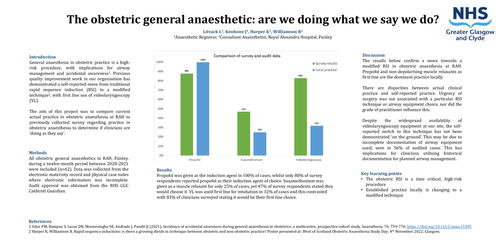
Propofol was given as the induction agent in 100% of cases, whilst only 88% of survey respondents reported propofol as their induction agent of choice. Suxamethonium was given as a muscle relaxant for only 25% of cases, yet 47% of survey respondents stated they would choose it. VL was used first line for intubation in 32% of cases and this contrasted with 83% of clinicians surveyed stating it would be their first line choice.
Discussion
The results below confirm a move towards a modified RSI in obstetric anaesthesia at RAH. Propofol and non-depolarising muscle relaxants as first line are the dominant practice locally.
There are disparities between actual clinical practice and self-reported practice. Urgency of surgery was not associated with a particular RSI technique or airway equipment choice, nor did the grade of practitioner influence this.
Despite the widespread availability of videolaryngoscopy equipment at our site, the self-reported switch to this technique has not been demonstrated ‘on the ground’. This may be due to incomplete documentation of airway equipment used, seen in 56% of audited cases. This has implications for clinicians utilising historical documentation for planned airway management.
Key learning points
References
1 Odor PM, Bampoe S, Lucas DN, Moonesinghe SR, Andrade J, Pandit JJ (2021), Incidence of accidental awareness during general anaesthesia in obstetrics: a multicentre, prospective cohort study. Anaesthesia, 76: 759-776. https://doi.org/10.1111/anae.15385
2 Harper K, Williamson R. Rapid sequence inductions: is there a growing divide in technique between obstetric and non-obstetric practice? Poster presented at: West of Scotland Obstetric Anaesthesia Study Day; 4th November 2022; Glasgow.